
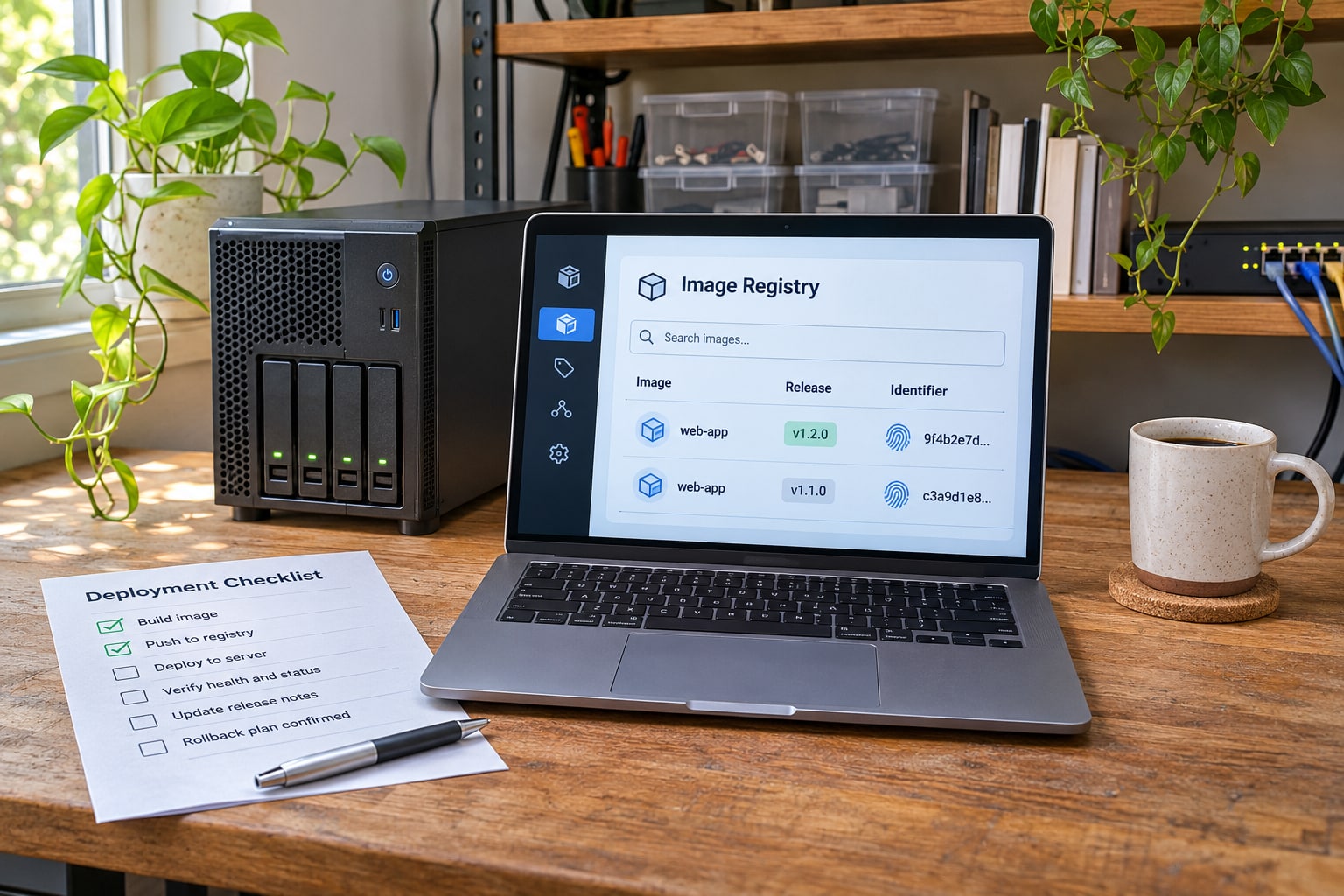
The same Compose file can produce a different result if an image tag was reassigned between downloads. Conversely, permanently pinning a reference can leave a service on an old release. A digest helps identify what you deploy; it does not replace a maintenance policy.
Docker explains the difference between tags and digests. This practical article was checked on November 9, 2026. It concerns deployment traceability, not a newly introduced Compose feature.
Identify the expected content
A tag is a convenient name; a digest identifies immutable content. Our recommendation is to retain both in release records: the advertised version and the reference actually selected.
Consider multi-platform images: a reference may identify an index containing several architecture variants. Check what you pin and the server's platform. Validation on an ARM workstation does not establish equivalent behaviour on an AMD64 deployment target.
Never invent a digest to complete a command. Obtain it from the expected source and connect it to a version whose origin you understand.
Separate downloading from replacing the service
The docker compose pull documentation specifies that the command downloads images but does not start containers based on them.
Our advice is to distinguish three checks: the image is available, the service uses the expected reference and the user workflow works. A successful download alone does not establish that the running application changed.
Avoid broad cleanup during a delivery too. Deleting images or volumes “just to be sure” can complicate recovery and affect unrelated data. Name the service and the intended change before operating on a shared host.
Plan updates when you start pinning
We recommend a review frequency suited to the service's exposure. Each digest change should have a source, a test result and an owner.
For a security fix, assess priority without assuming pinning protects against every vulnerability. A precisely identified version can be precisely vulnerable. Equally, automatically following a mutable tag does not establish that the replacement was validated for your application.
Keep the selection process understandable enough that another maintainer can repeat it rather than treating an opaque hash as proof of approval.
Test recovery with persistent data in mind
Keeping the previous image helps, but is insufficient if the new version changed a schema or persistent files. Document compatibility before releasing.
Also consider registry availability and access to the previous reference. A recovery plan depending on a download that is no longer possible remains fragile.
This complements our Compose secrets article. Image provenance, secret access and volume protection are distinct responsibilities that need to be managed together.
Cover visual: generated editorial illustration, not an official screenshot.


Join the discussion
Comments
Loading comments…