
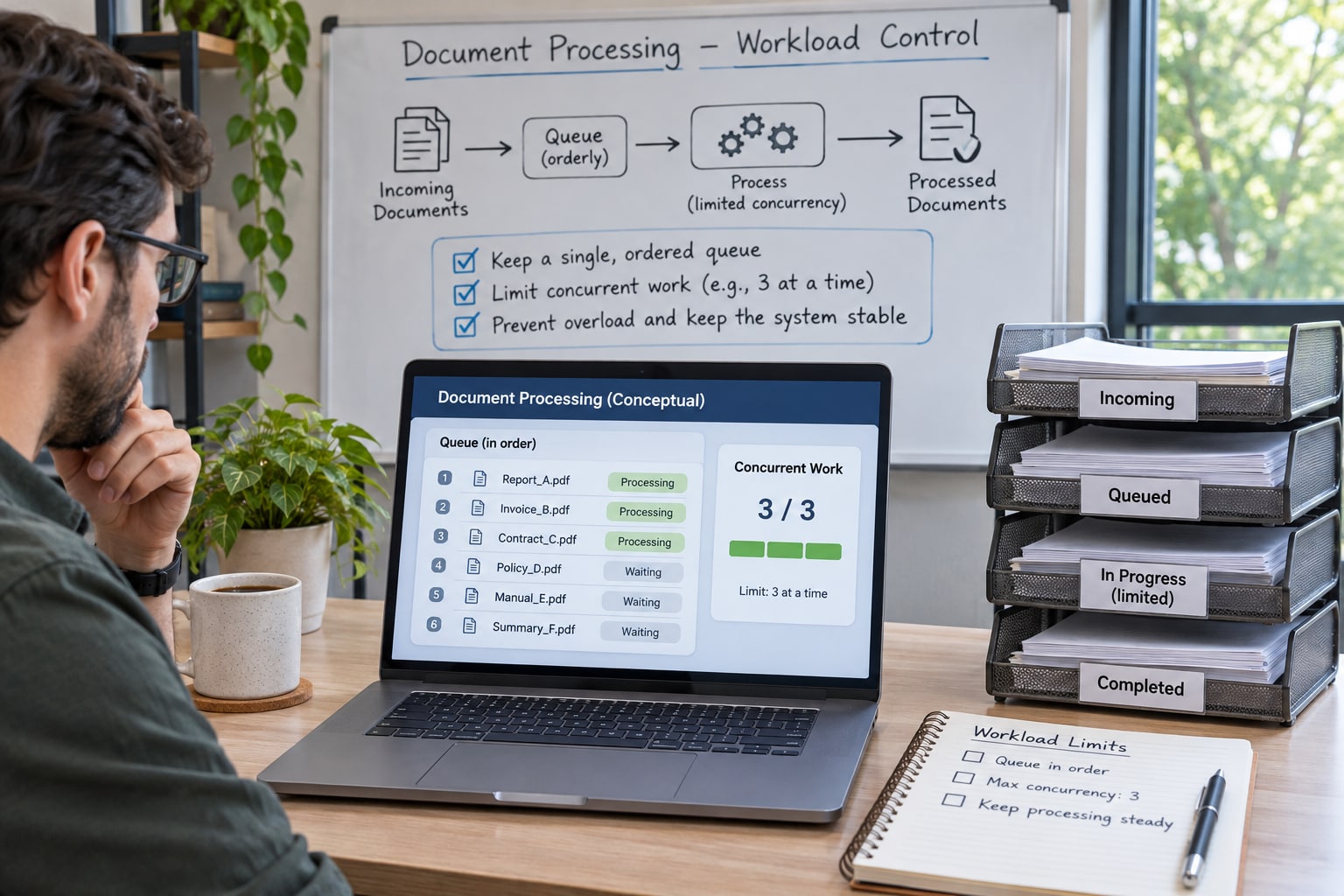
A workflow can accept more tasks without its downstream systems being ready to absorb them. On November 5, AWS announced higher default Lambda durable functions quotas, including running executions and several management APIs.
The official announcement raises running durable executions per account from one million to five million in the relevant regions. It distinguishes three regions with double those values, including Europe (Ireland). This is not a new throughput guarantee for every application.
Identify the relevant quota category
Our recommendation is to establish the actual constraint: retained running executions, start rate or management calls. Increasing one category does not necessarily resolve saturation elsewhere.
Record the account, region and affected endpoint. A value in a general announcement does not replace checking your environment and the limits applicable to the service you use.
A durable execution waiting for external work is not equivalent to active computation consuming resources at the same rate. Describe those states separately in your load model.
Keep an admission limit
Consider a document-processing queue. Many workflows might resume while a conversion API or destination database accepts much less traffic.
Define a concurrency budget around those dependencies instead of immediately filling available capacity. A higher quota provides headroom, not an instruction to accelerate every start.
Vary load in a test environment and observe retries, delays and rejections. A trial where every dependency responds instantly misses an important part of the problem.
Document what happens when the downstream service slows down. Otherwise, the first operational response may be to start even more work at precisely the wrong moment.
Observe management traffic too
AWS also increases management and inspection request limits. For your own operations, review dashboard and script polling frequency.
Excessively frequent observation can consume time and complicate diagnosis without improving detection. Choose useful signals: blocked work, oldest task age and failures requiring intervention.
In particular, avoid an uncontrolled retry loop when a remote system rejects load. More permitted management calls are not a reason to retry every failure immediately.
Connect capacity with expected cost
Before expanding a queue, estimate volumes, durations and downstream services. Billing is not explained by a quota number alone. Check the prices and conditions applicable to your configuration when making the decision.
This complements our Lambda bandwidth article. The announcements concern different dimensions. An operable architecture can explain which boundary protects the service and how that boundary should evolve as demand grows.
Cover visual: generated editorial illustration, not an official screenshot.

Join the discussion
Comments
Loading comments…