
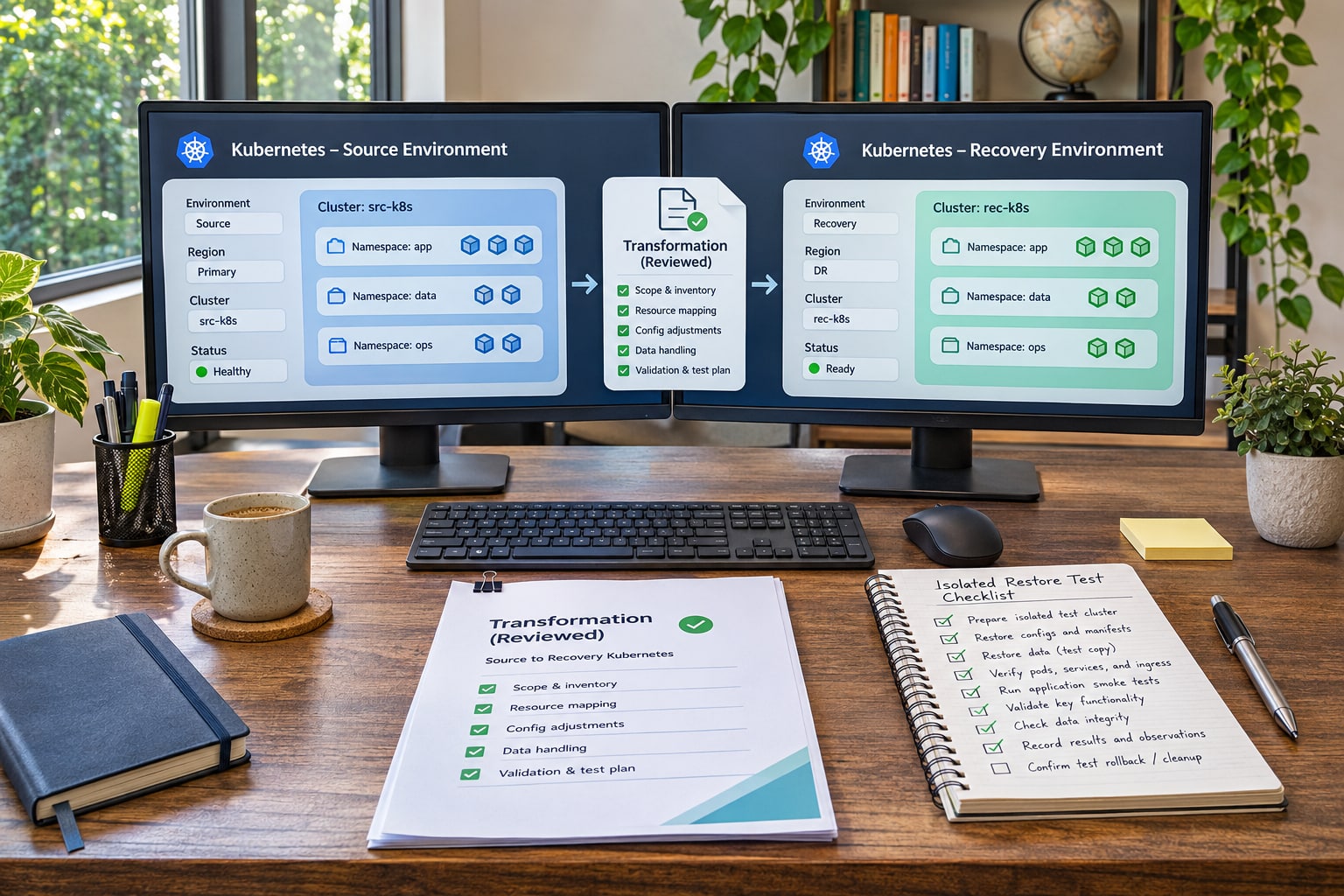
A restore can recreate Kubernetes resources while leaving an application connected to the wrong environment. AWS Backup now supports resource modifiers during EKS backup restoration. Automating transformations does not certify that the recovered service is isolated or usable.
The November 12 announcement describes YAML rules for source-bound references, including IAM roles, database endpoints and ECR registry addresses. Cross-account and cross-Region recovery are prominent use cases.
Define the intended outcome first
Our recommendation is a recovery contract before a transformation file. Which account receives resources? Which external services remain permitted? Who accepts the resulting environment?
A test cluster should not send genuine notifications or process customer orders merely because it recovered a manifest. List external effects and assign owners.
Also state which data and dependencies the procedure does not recover. That boundary should be understandable without inspecting every script during an incident.
Build a reviewed mapping
For each source-specific reference, record its target value, justification and verification method. Avoid unreviewed global replacement of short strings.
Version rules with the recovery scenario. A rule that worked during one exercise can become outdated after an architecture change even when the YAML remains valid.
Have the target environment's owner review the mapping. A plausible role or registry name does not demonstrate appropriate permissions or content.
Include the expected handling of references that must not survive. An unexplained unchanged field is a review question, not an automatic success.
Exercise away from live flows
Use a controlled environment with limited access and suitable data. Observe changes, unchanged values and failures.
We recommend checking destinations before functional tests. A page loading successfully is insufficient: a background operation might still contact production.
Do not copy credentials into a widely shared report. Keep necessary evidence in an appropriately restricted location.
Define how to stop an unsuccessful exercise and who makes that decision. Recovery testing should not introduce an uncontrolled second incident.
Measure complete recovery
Object creation time is only one stage. Record verification, access restoration and operational acceptance as well.
For our fictional scenario, acceptance might require expected data, a successful read, a controlled test write and no unintended effect on the source. These are proposed criteria, not results from a test performed by this publication.
Keep actionable failure records: applied rule set, procedure version and blocked step. Otherwise the next attempt repeats the same uncertainty.
Maintain the recovery dossier
Assign an owner and review date. Changes to identities, registries or dependencies should prompt a check of the corresponding rules.
This complements our restore-testing article. Useful automation reduces repetitive editing without removing validation. Recreating resources and recovering a reliable service remain different goals.
Visual: generated editorial illustration, not an official screenshot.


Join the discussion
Comments
Loading comments…