
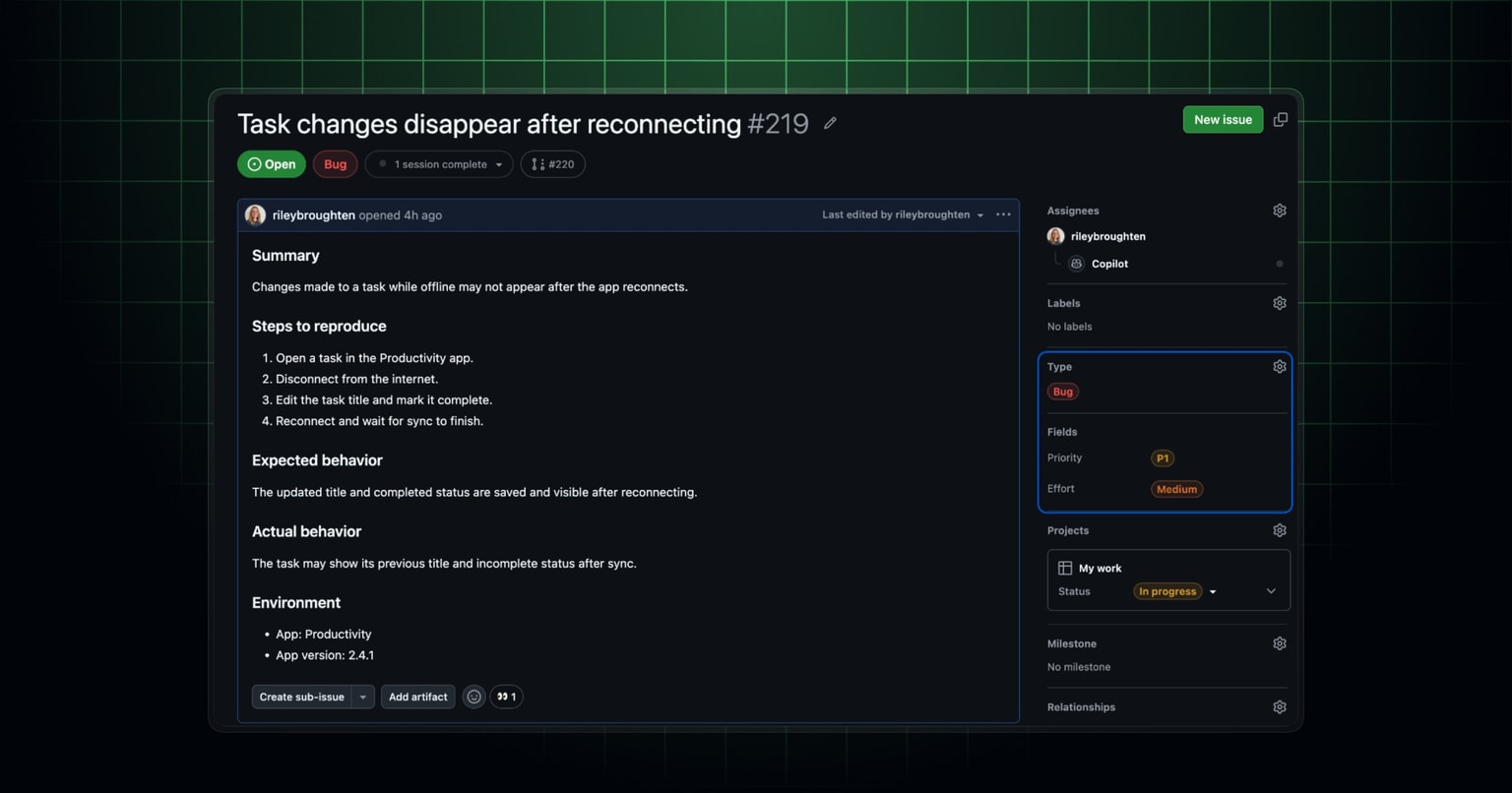
A repository owned by one person may support an entire team. GitHub has made issue types and fields generally available for repositories owned by personal accounts, giving maintainers a more structured way to organise requests.
The November 11 announcement describes customisation through account settings. Default types include Bug, Task and Feature; priority and effort are among the initial fields. The cover is GitHub's official example, not our own repository.
Start with a small vocabulary
Choose categories that support actual decisions. Why does distinguishing a bug from a feature request matter in this project? Who resolves a request containing both?
Write one explanatory sentence for each type. If two people classify the same example differently, improve the definitions before adding options.
For a small project, three understood choices can be more valuable than an exhaustive taxonomy. Classification should help the next action rather than become another project.
Give fields a meaning
A priority field does not define what takes precedence. Our recommendation is to distinguish importance, estimated effort and delivery commitment.
For a target date, state whether it is a wish or an agreed commitment. Otherwise the board can create a promise that nobody made.
GitHub supports several field formats and their use in projects. Choose information contributors can provide without inventing an answer merely to fill a space.
Handle existing issues deliberately
Trial the convention on representative requests: an incident, improvement, internal task and misdirected question. Inspect cases that remain difficult to classify.
Do not reclassify the whole archive without a purpose. Preserve useful information in the issue text and explain changed conventions to its participants.
A vocabulary migration should help people find the work, not merely produce a fully populated board.
Automate after stabilising
The announcement includes API and webhook support. Before automation, decide what should happen when a field is missing or renamed.
Keep an authoritative definition and an owner for conventions. Poorly explained automation can create consistent but incorrect classification.
This complements our stacked pull-request review article. Planning a request and reviewing its implementation are different stages. Clearer issues should make the transition easier.
Visual: official GitHub screenshot from the linked announcement, resized without cropping.

Join the discussion
Comments
Loading comments…