
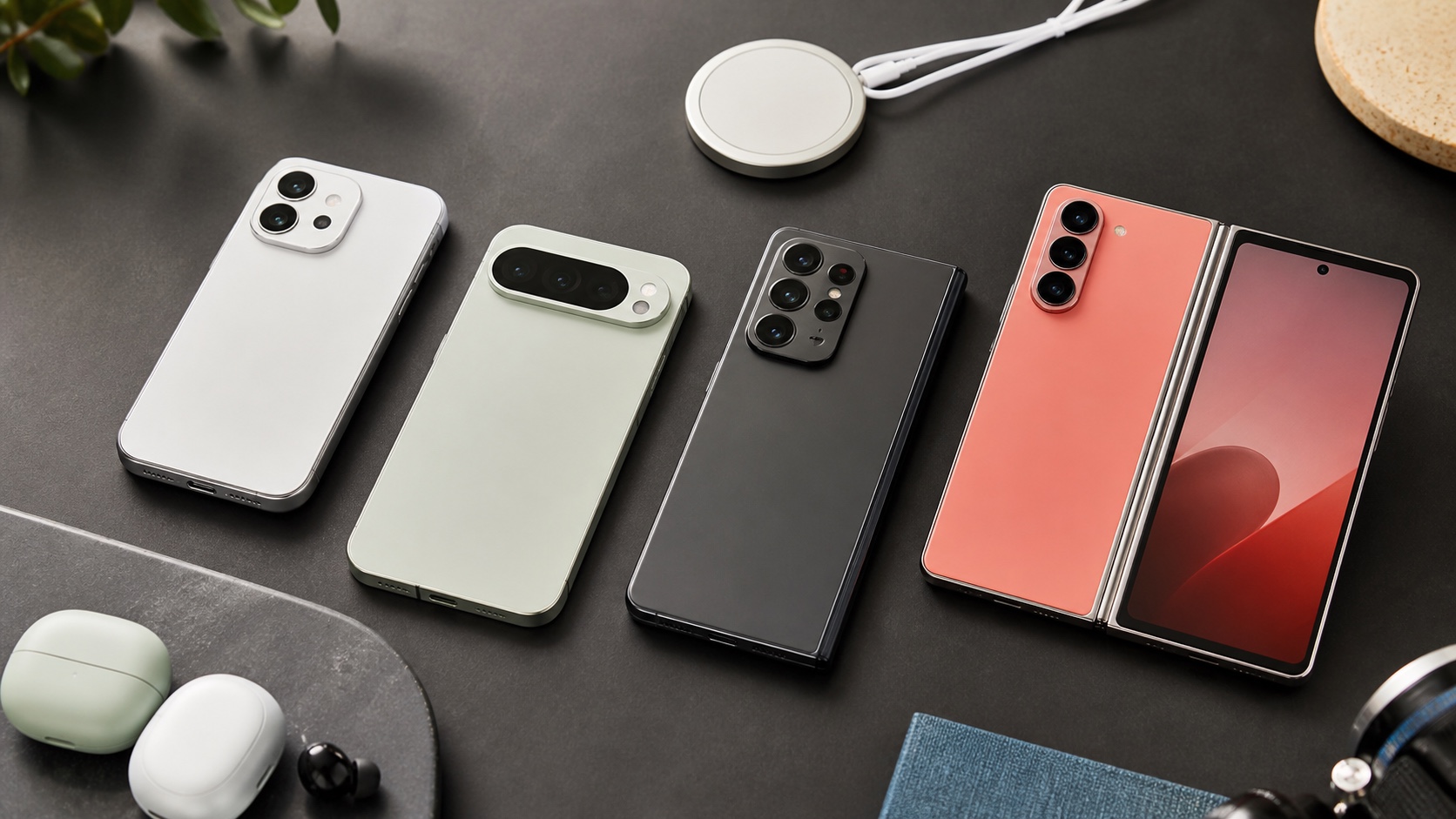
Google has opened French preorders for four Pixel 11 formats: Pixel 11, Pixel 11 Pro, Pixel 11 Pro XL and Pixel 11 Pro Fold. The standard model starts at EUR999. Every device is built around Tensor G6, Gemini Intelligence, a new set of camera features and seven years of updates, but the widening price range makes the choice more complicated than simply picking a small or large screen.
The useful question is not which Pixel has the longest specification sheet. Buyers should identify the differences they will notice every day: telephoto hardware, physical size, display, storage, a folding screen or Pro-only features. Trade-in promotions can lower the bill, but they should not hide the total price or encourage replacing a phone that still receives reliable support.
The short answer
| User profile | Model to consider | Why |
|---|---|---|
| My recent Pixel still works well | Keep it | Seven years of support reduce the need to upgrade after one generation. |
| I want the straightforward option | Pixel 11 | 6.3-inch display, at least 256GB, Tensor G6 and a 48MP main camera. |
| I want the best camera in a compact body | Pixel 11 Pro | Telephoto camera and Pro zoom without moving to a large display. |
| I mainly want a larger screen | Pixel 11 Pro XL | The Pro experience on a 6.8-inch panel, with a less pocketable body. |
| I want to replace a phone and small tablet | Pixel 11 Pro Fold | An 8-inch inner display and real multitasking, with foldable compromises. |
Pixel 11 is now a full-priced flagship
At EUR999, the standard Pixel 11 is not an inexpensive entry model. Google gives it a coherent foundation: a 6.3-inch Actua display rated for up to 3,000 nits, 12GB of RAM, at least 256GB of storage and the Tensor G6 chip. The company also claims more than 30 hours of battery life under its test conditions and wired charging that can reach roughly 55% in 30 minutes.
The main camera uses a 48-megapixel sensor with higher claimed light sensitivity than its predecessor. Super Res Zoom reaches 30x, although buyers should separate software reach from captured detail. At long range, algorithms reconstruct part of the image. Independent reviews will need to assess textures, faces and moving subjects rather than the maximum number alone.
Starting at 256GB is a practical improvement for photos, video and large applications. It also reduces pressure to buy cloud storage. For many people, that capacity will be more noticeable than a theoretical performance increase that ordinary apps rarely exploit.
What the Pro models actually add
Pixel 11 Pro retains a compact 6.3-inch display, while Pro XL grows to 6.8 inches. Both use a Super Actua LTPO panel rated for up to 3,600 nits. Adaptive refresh can save power when the picture is static, but brightness and smoothness are the most visible benefits.
The important difference is the camera system. Pro devices add a telephoto lens and Pro Res Zoom up to 120x. That figure does not promise a perfect photograph at such a distance. It shows how far the phone can frame by combining optics, stabilization and AI processing. For children, pets, concerts and travel, the presence of a genuine telephoto lens matters more than the largest advertised zoom value.
Google also introduces HiLight on Pixel 11 Pro. A colored rear light can indicate an important call or notification without requiring users to look at the screen. It is a small feature with an interesting goal: making the phone less demanding. Its value will depend on customization and whether it reduces interruption instead of creating another one.
Choosing between Pro and Pro XL is therefore mostly ergonomic. The larger phone is better suited to video, reading and games, but occupies more space and is harder to operate with one hand. Buying XL for status alone may result in a less comfortable device every day.
Pro Fold is not merely a more expensive Pixel
Pixel 11 Pro Fold combines a 6.5-inch cover display with an 8-inch inner screen. It is designed for people who want two applications side by side, larger documents, messaging alongside reference material or video on a small-tablet surface. A foldable earns its price through the time spent open.
The format also introduces tradeoffs: folded thickness, weight, a hinge, a visible crease, more complicated cases and potentially expensive repairs. Google highlights a tougher back panel and display brightness up to 3,600 nits, but those claims do not replace drop, endurance and repairability tests.
Buyers should start with their current habits. Someone who rarely uses split-screen apps may be better served by a conventional Pixel and a separate tablet. A mobile professional who regularly compares plans, spreadsheets or documents could genuinely carry one fewer device.
Tensor G6 puts AI ahead of benchmark racing
Tensor G6 powers the entire family. Google claims 50% more TPU compute for artificial-intelligence features. It supports Gemini Intelligence, conversational photo editing, structured voice input, some translation features and computational photography.
That strategy does not automatically make Tensor G6 the fastest general-purpose or gaming processor. Google is optimizing the connection between its models, Android and its hardware. Heat, battery life, modem stability and real task completion matter more than a staged AI demonstration or a single benchmark score.
Gemini Intelligence can work across applications and offer more proactive assistance. That convenience makes permissions more important. Any feature able to read a screen, retrieve personal information or perform an action should explain its data access and provide a clear off switch. A personal assistant should not become blanket consent.
Pixelsnap simplifies accessories
Pixel 11 includes Pixelsnap, a magnetic system for aligning chargers and accessories. It solves a real friction point: the phone sits over the charging coil correctly, and stands can hold it without a clamp.
Mechanical fit, charging power and certification are still different questions. An accessory may attach securely without delivering maximum charging speed. A thick or poorly aligned case can also reduce performance. Existing accessories should be checked individually rather than assumed compatible because they share a circular shape.
Launch promotions are not guaranteed savings
The French Google Store advertises trade-in values of up to EUR780 for Pixel 11 and up to EUR980 on selected Pro models, including temporary bonuses through September 1. These are maximum figures dependent on the submitted device, its condition and final inspection. They are not universal discounts.
Pro purchases also include six months of Google AI Pro and three months of YouTube Premium under the offer terms. That bundle has value only for someone who intended to use those subscriptions. Buyers should note the trial end date and subsequent price to prevent an unwanted renewal.
A fair comparison begins with the amount charged, subtracts the actual confirmed trade-in and adds necessary accessories. It should also consider what the old phone could fetch through another resale route. A convenient trade-in can be worthwhile, but it is not always the most valuable option.
Should you preorder or wait for reviews?
Preordering makes most sense when the enhanced trade-in applies to a device that was already due for replacement. Waiting otherwise provides independent measurements of battery life, heat, modem performance, night photography and durability. It also gives carriers and retailers time to compete.
Owners of a Pixel 8, 9 or 10 in good condition have little reason to rush. Seven-year update support is an argument for keeping hardware. Pixel 11 becomes compelling when it solves a defined problem: insufficient storage, a missing telephoto camera, a worn battery or a genuine need for a folding screen.
For a new purchase, standard Pixel 11 appears to be the rational center of the range. It has the same chip generation, generous storage and the main software features. Pixel 11 Pro targets photography without requiring a large body. Pro XL primarily buys display area, while Pro Fold changes the way the device is used. The best Pixel 11 is not the most expensive one, but the model whose differences still matter after the launch offers end.
Join the discussion
Comments
Loading comments…