
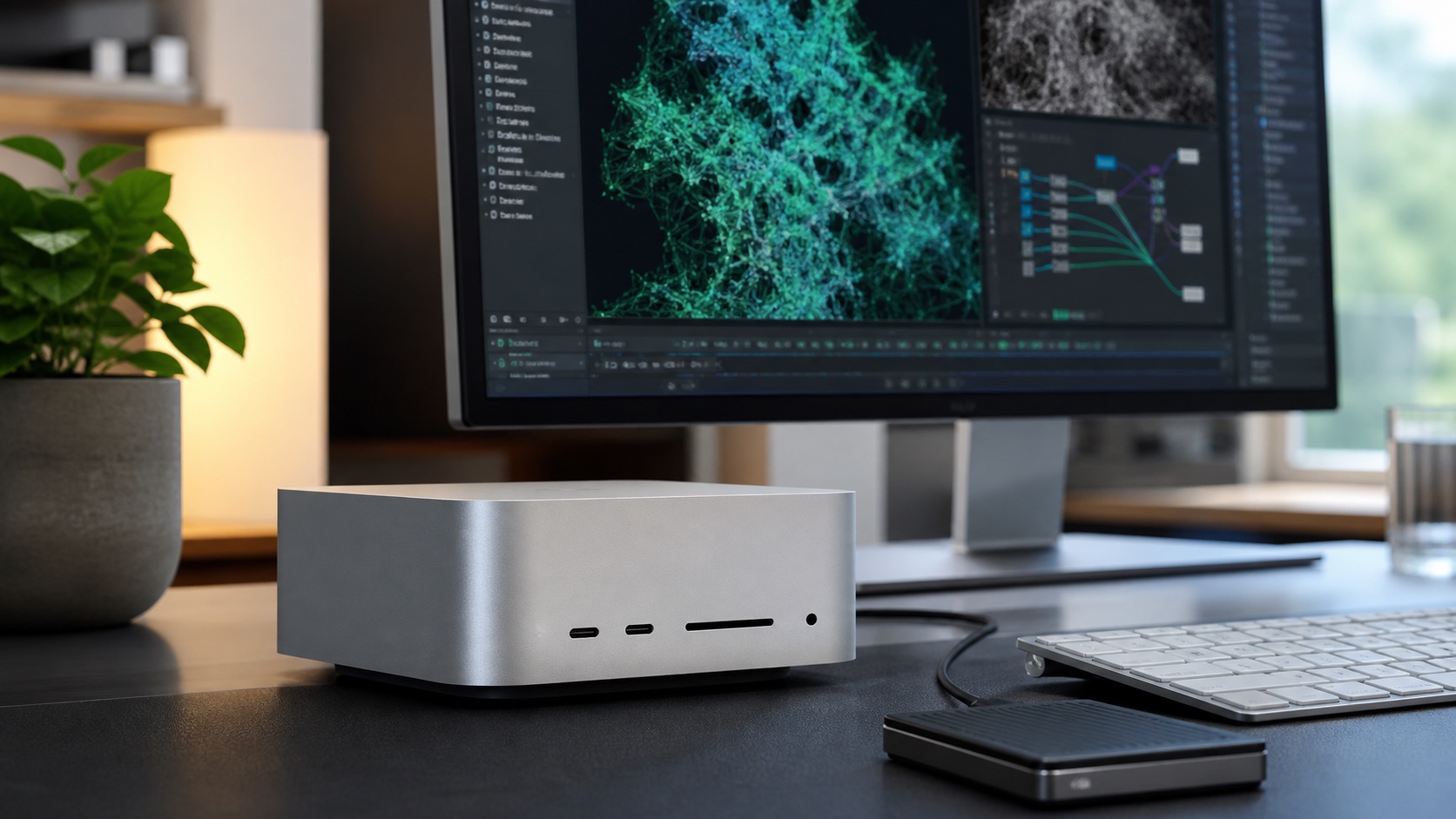
Apple is refreshing the Mac mini with an M6 chip for mainstream buyers and M5 Pro for professional workloads. The compact desktop ships September 22 with more cores, stronger AI acceleration and updated connectivity.
The short answer
| Question | Answer |
|---|---|
| When is it available? | September 22, 2026. |
| How much base memory? | 16 GB of unified memory. |
| What is new for networking? | Wi-Fi 7, Bluetooth 6 and 2.5 GbE, configurable to 10 GbE. |
| Should an M4 owner upgrade? | Rarely for office work; gains target graphics, AI and selected heavy processing. |
What the M6 actually changes
M6 combines a 12-core CPU with a 12-core GPU containing Neural Accelerators. Apple claims up to four times M4’s AI performance, twice the graphics performance and 40% faster CPU performance. These are vendor-selected benchmarks and will vary substantially by application.
For browsing, video calls and office work, a recent Apple Silicon Mac is already responsive. Differences should be more visible in 3D rendering, encoding, development and AI models that use the GPU and unified memory effectively.
Is 16 GB still enough?
The base configuration remains at 16 GB and can reach 32 GB. That is reasonable for family or conventional business use. A machine intended for Xcode, Docker, heavy photography or local AI should consider 24 or 32 GB because memory cannot be upgraded later.
Storage follows the same logic. A 256 GB SSD fills quickly with photos, virtual machines or models. Fast external storage often costs less than Apple’s upgrade, although apps and system caches still occupy the internal volume.
Who needs M5 Pro?
The M5 Pro variant increases core count, memory capacity and graphics capability. It targets sustained video editing, large builds and desks replacing a tower. Compare the final configuration with Mac Studio and include a display, keyboard and mouse in the budget.
The always-on AI argument
Apple positions Mac mini as a computer for continuously running local models and agents. Its size and efficiency fit the role, but results depend on model size, quantization and selected memory. A model that cannot remain in memory loses much of the local-compute advantage.
Local AI may reduce data transfers and remove token billing. It does not guarantee privacy when an application still calls external services. Inspect network behavior and product terms.
Buy or wait?
Intel Mac and M1 Mac mini users will see a substantial jump. M2 owners may value connectivity and specialized performance. An M4 owner should identify a measured bottleneck before replacing a working machine.
Mac mini M6 is a solid upgrade, especially for graphics and local AI. The purchase decision depends less on the chip name than on memory and storage selected at checkout, two resources that cannot be improved later.

Join the discussion
Comments
Loading comments…