
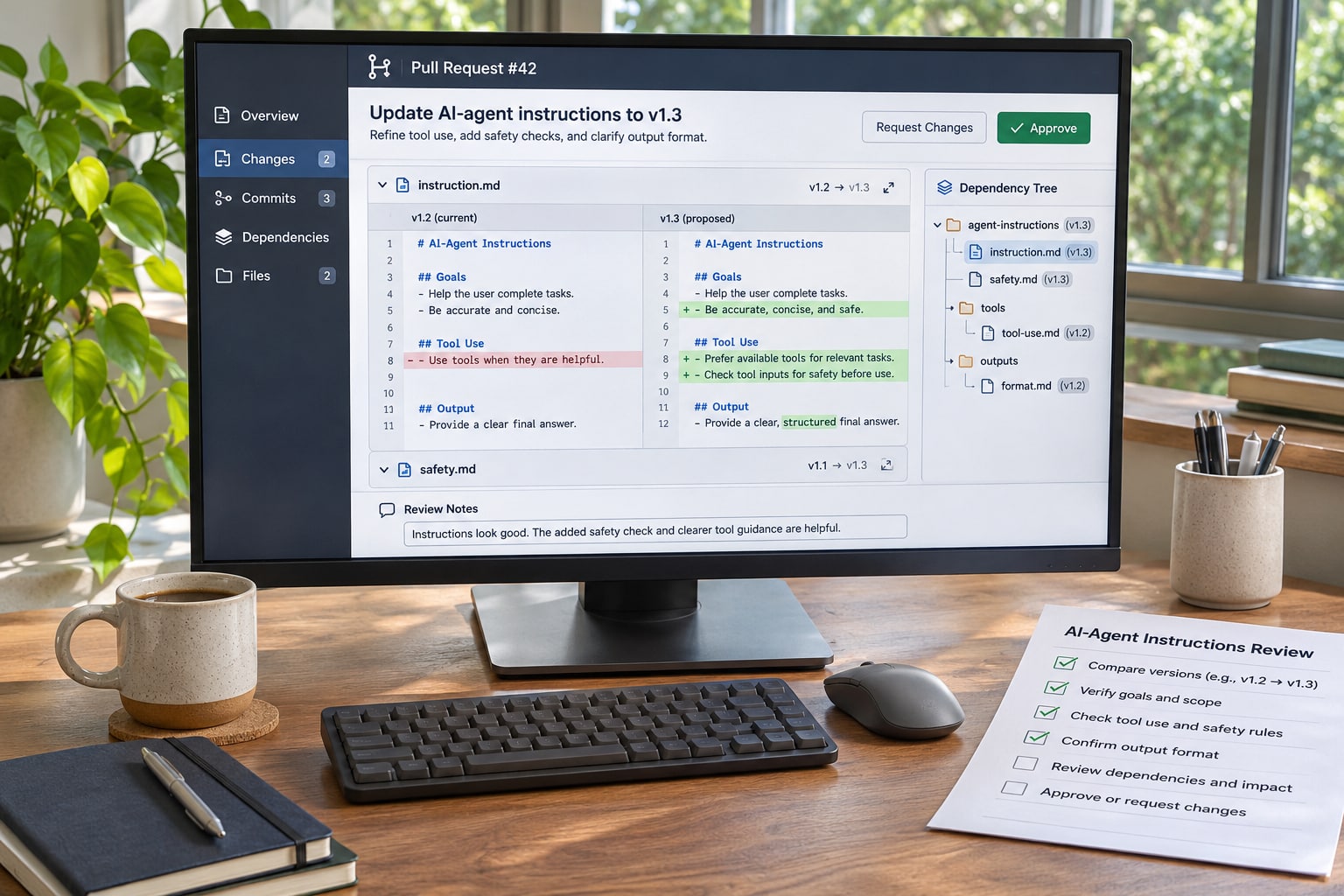
An agent's dependencies are not limited to executable libraries. Shared instructions, prompts and skills can change its behaviour too. On November 3, GitHub announced Agent Package Manager support in Dependabot version updates.
The announcement covers supported Git dependencies in apm.yml and regeneration of apm.lock.yaml when present. It explicitly concerns version updates, not security updates. That boundary should remain visible in review procedures.
Treat instructions as a behavioural change
Our recommendation is to ask what an agent might do after the update, not merely whether a file is syntactically valid. New instructions can change tool use, file access or how an answer is prepared.
A short diff does not necessarily imply a small functional change. Equally, a substantial rewrite does not automatically expand permissions. Connect each relevant change to an observable scenario before drawing a conclusion.
This review should name an owner. Otherwise, a dependency update can pass between application and infrastructure teams without anyone checking its effect on the agent's task.
Establish what is actually tracked
GitHub describes an apm entry in .github/dependabot.yml, pointing to the manifest's directory and an update schedule. The supported-ecosystems documentation helps check the recognised scope.
We advise inventorying manually copied files, Git references and external tools separately. A Dependabot pull request does not establish coverage of the entire agent environment. Do not add configuration without first checking the format your own project actually uses.
Review before automatically merging
For validation, use an environment without real secrets and a representative set of tasks. Compare modified files, proposed actions and failures. Record what the agent was allowed to read and write during the test.
One successful output does not validate every use case. Retain human review for changes involving permissions, commands or sensitive data. Locking a version helps comparison; it does not make that version's contents harmless.
Our suggested acceptance notes should describe expected behaviour and unacceptable actions, not merely include a screenshot of a completed run.
Prepare a controlled return
Keep the earlier reference and the test results. Reverting instructions does not automatically restore files or services the agent may already have changed. Decide who will review those effects and how an unexpected result will be escalated before approving deployment.
This work complements our article about contextual privacy for agents. Updates can become more visible without becoming a blanket authorisation: a proposed dependency remains a maintenance decision that somebody needs to assess.
Cover visual: generated editorial illustration, not an official screenshot.



Join the discussion
Comments
Loading comments…