
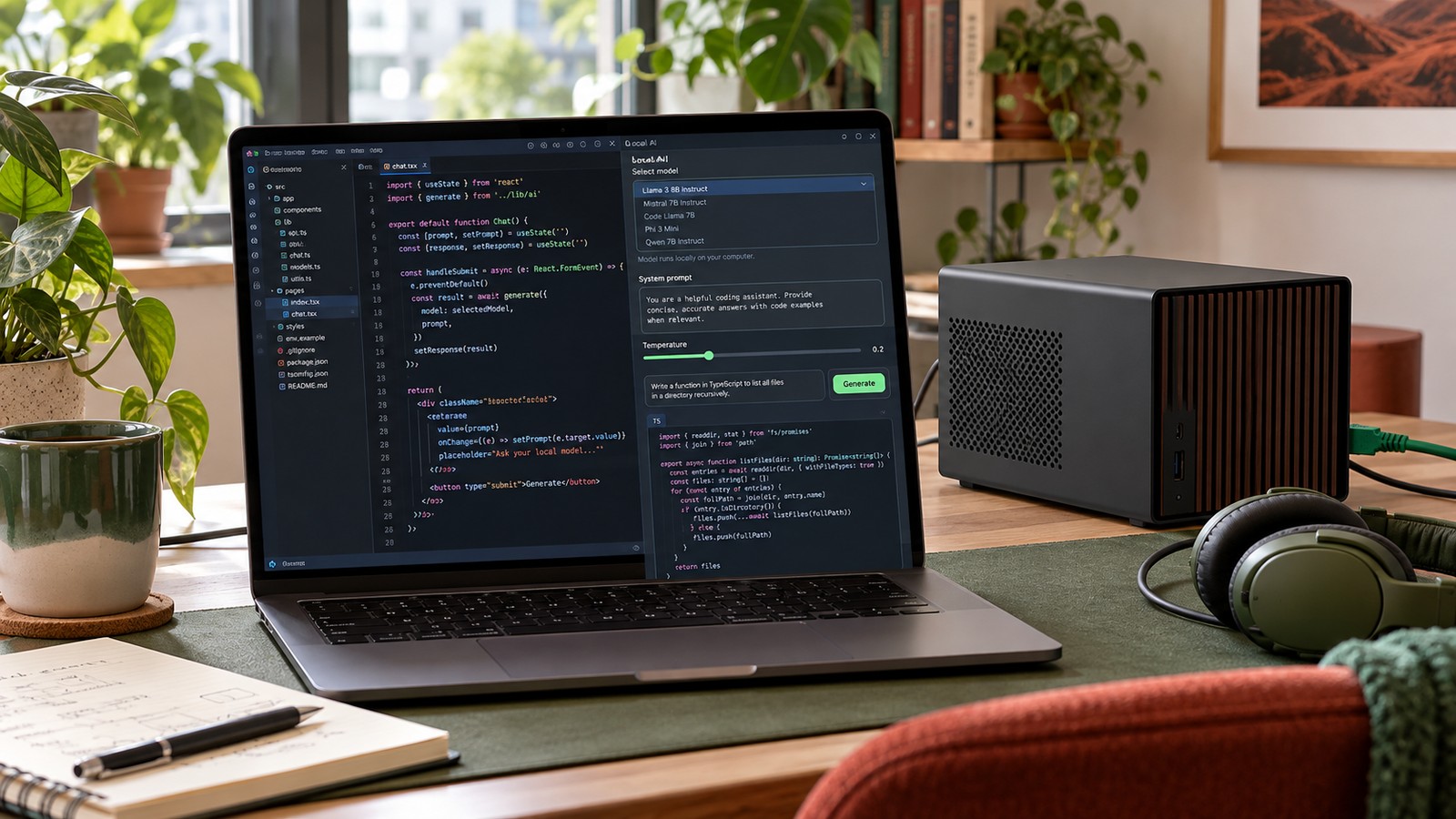
GitHub announced a new Copilot CLI capability on October 7: discovering models from a running local Ollama instance through the /model selector. For developers, it reduces the friction between their usual assistant and an engine installed on their computer. It does not automatically make the entire tool an offline application.
What the selector actually does
According to GitHub's announcement, discovery starts in version 1.0.94-0. Ollama must already be running, and the model must support tool calling and streaming. The selector therefore replaces neither engine installation nor model downloads.
That distinction prevents an initial misunderstanding: a local entry does not guarantee suitability for every task. A general conversation model might write a readable answer without reliably operating tools. For a coding assistant, that second ability matters as much as the prose.
The provider address is a trust boundary
Before accepting a configuration, check its provider and endpoint. A familiar name does not prove that requests stay on your computer. The configuration documentation also explains the separate purpose of COPILOT_OFFLINE=true: selecting a local model and enabling offline operation are different choices.
Offline mode does not stop an explicitly configured remote provider from receiving requests. Likewise, a local model does not by itself disable every other application communication. For sensitive code, our recommendation is to inspect the full data path instead of relying on a label.
Start with a disposable repository
A useful first comparison can involve a small correction: adding a function test, explaining a query or proposing a validation change. Use a repository without secrets and keep the prompt identical across models.
Assess correctness, but also the files consulted, tools requested and unexpected edits. A quick answer is not compelling if it requires a lengthy human repair afterwards. Conversely, a slower model may still be valuable for a repetitive, narrowly defined task.
On the computer, monitor memory, power consumption and responsiveness of other applications. We are not publishing a hardware benchmark here: the constraints depend on your chosen model and configuration.
Keep permissions separate from model selection
Where the engine runs does not change the severity of a destructive command. A local assistant can suggest deleting a file, executing a network script or changing a production setting.
Retain change reviews and appropriate permissions. Start by asking for an analysis or a limited patch, then run the usual tests. The benefit of this integration is making comparisons more accessible, not replacing code review with automatic trust.
This also makes ownership clearer inside a team. Record which model and configuration produced a proposed change, so a reviewer can reproduce the experiment rather than guessing what happened on somebody else's laptop.
Our article about Gemini connected-app permissions explores a related issue: connecting more tools requires clearer boundaries.
Cover visual: an illustration generated for this article, not an official service screenshot.


Join the discussion
Comments
Loading comments…