
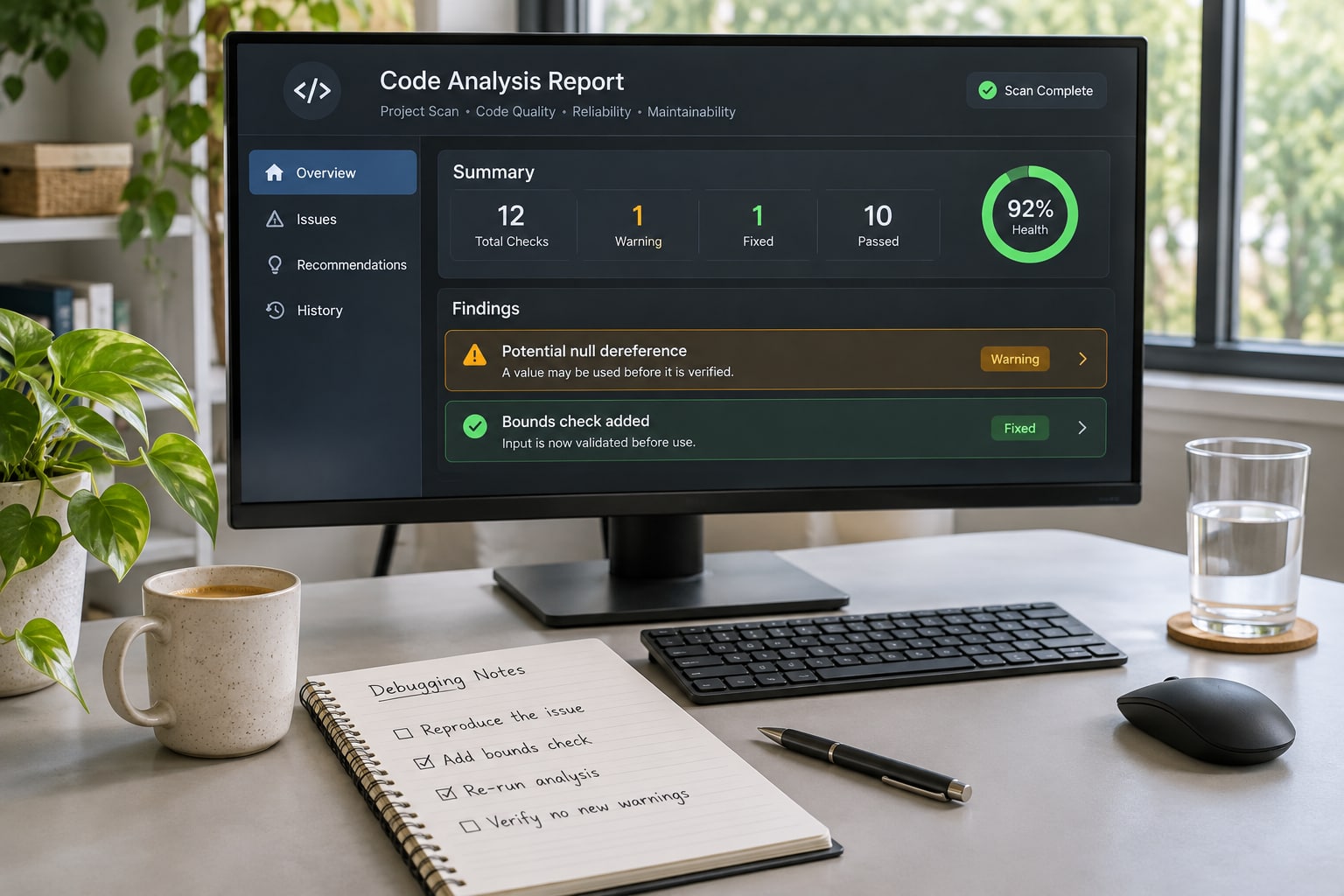
A dashboard shows fewer alerts after the analysis engine is updated. Good news? Possibly, but the number is not enough. CodeQL 2.27.4 changes the accuracy of some queries and their metadata: a counter moving is not, by itself, a measurement of code security.
GitHub explained these changes in its November 4 announcement. The CLI release notes are dated November 2. These are different publication dates, not two successive versions.
Compare the same code and configuration
Our recommendation is to retain a reference result: analysed commit, configuration, languages and engine version. Mixing code changes with engine changes makes differences difficult to explain.
Take a few representative alerts and examine their data paths. If an alert disappears, investigate whether the query now recognises an existing safeguard or whether your configuration stopped running it. The aim is not to preserve a counter artificially; it is to understand the difference.
Record the comparison in a place the next reviewer can find. An unexplained improvement can be just as misleading as an unexplained regression.
Separate remediation from reclassification
The announcement lists adjustments in Java/Kotlin, Rust and C/C++, alongside CWE metadata corrections. A category change in an export does not necessarily indicate a code fix.
We advise explaining this distinction to people tracking trends. Otherwise, a monthly report can credit remediation work for a change caused by the tool. Compare identifiable findings, not only the totals presented to management.
Check downstream consumers
The release also addresses some CLI messages and file checks during pack preparation. For your own pipeline, review scripts that expect JSON or extract categories.
A report produced without an error can still be misinterpreted downstream. Test against a validation repository and inspect dashboard import, filters and notification rules. Avoid simultaneously changing every exclusion simply to reproduce a previous result.
If another team maintains the reporting integration, agree on the expected schema and a sample output before deploying the update. A successful scan and a successful reporting chain are related but distinct checks.
Keep contextual review for important findings
Static analysis supplies evidence; it does not always establish a service's actual exposure. For a priority finding, relate the reported code to an entry point, accepted data and safeguards that are genuinely present.
Record triage decisions and their reasoning. An alert dismissed without explanation becomes harder to reassess when either code or engine changes.
This complements our article about scanning AI applications. The issue here is interpreting results consistently through an engine update, not claiming universal coverage of every risk.
Cover visual: generated editorial illustration, not an official screenshot.

Join the discussion
Comments
Loading comments…