

etcd 3.7 is the new stable branch of the key-value store holding critical state for many Kubernetes clusters. It adds RangeStream, more efficient key reads, lease improvements and a major cleanup of historical dependencies. Patch release 3.7.1 has been available since July 23, 2026.
An etcd upgrade is not the same as updating a stateless application. A poor sequence can remove too many members, lose quorum or turn a rollback into a full restore. The project documents a zero-downtime rolling upgrade from 3.6, provided that precise prerequisites are met.
The short answer
| Check | Requirement before upgrading |
|---|---|
| Starting version | Every member must run etcd 3.6.11 or later. |
| Version jump | Upgrade one minor version at a time. |
| Cluster state | Every endpoint must be healthy before starting. |
| Backup | Create, download and verify a snapshot. |
| Sequence | Replace one member, check health, then continue. |
| Simple rollback | Available while the cluster remains mixed 3.6/3.7. |
| After the final member | Plan for snapshot restore or the downgrade procedure. |
Users of managed Kubernetes should not replace control-plane binaries themselves. That responsibility normally belongs to the provider. This article targets self-managed clusters and applications that operate etcd directly.
Why 3.7 matters
RangeStream addresses memory and latency for large result sets. In etcd 3.6 and earlier, a large range response had to be buffered completely. The new RPC streams chunks, making client and server memory more predictable.
keys_only requests can now primarily use the in-memory index without loading every value from bbolt, except when sorting by value requires it. Systems traversing large key spaces should measure fewer backend reads and allocations.
Lease handling also changes. Revocation receives priority during overload and a fast renewal option avoids some waits. For Kubernetes, where leases support coordination and elections, behaviour under pressure matters as much as nominal throughput.
Historical debt is removed
etcd 3.7 boots entirely from v3 storage and removes several remaining v2store components. The v2 HTTP API, v2-on-v3 emulation, v2 discovery service and v2 client are gone. Modern installations should no longer depend on them, but an old platform or internal tool may expose hidden debt.
All deprecated --experimental-* flags are also removed. Their stable flags or feature-gate replacements already existed in 3.6. A systemd unit, static manifest or chart that still supplies an old name will prevent 3.7 from starting.
Audit arguments before the maintenance window across Kubernetes manifests, configuration files, environment variables and bootstrap scripts, not only the command shown in an operations document.
The 3.6.11 prerequisite is mandatory
Official guidance requires every member to run at least etcd 3.6.11 before moving to 3.7. Earlier 3.6 patches may not support the rolling upgrade correctly.
A team on 3.5 must first upgrade to 3.6, stabilise the cluster and schedule 3.7 separately. Combining two minor upgrades removes a diagnostic checkpoint and complicates rollback.
Before taking action, etcdctl endpoint status should confirm every member's version and etcdctl endpoint health its ability to commit a proposal. An open TCP port is not enough; the cluster must actually accept a Raft write.
A snapshot is a condition, not a checkbox
The guide recommends creating and downloading a snapshot before the operation. It should not remain only on the node about to change. Copy it to separate storage with its date, etcd version and restoration information.
An untested backup is an assumption. In staging, restore the snapshot into a fresh directory, start an isolated cluster and inspect representative keys. This rehearsal also measures restoration time, which is often missing from recovery objectives.
Retain certificates, member configuration, peer and client URLs, and the process for reconstructing control-plane manifests. The data file alone does not describe the whole infrastructure.
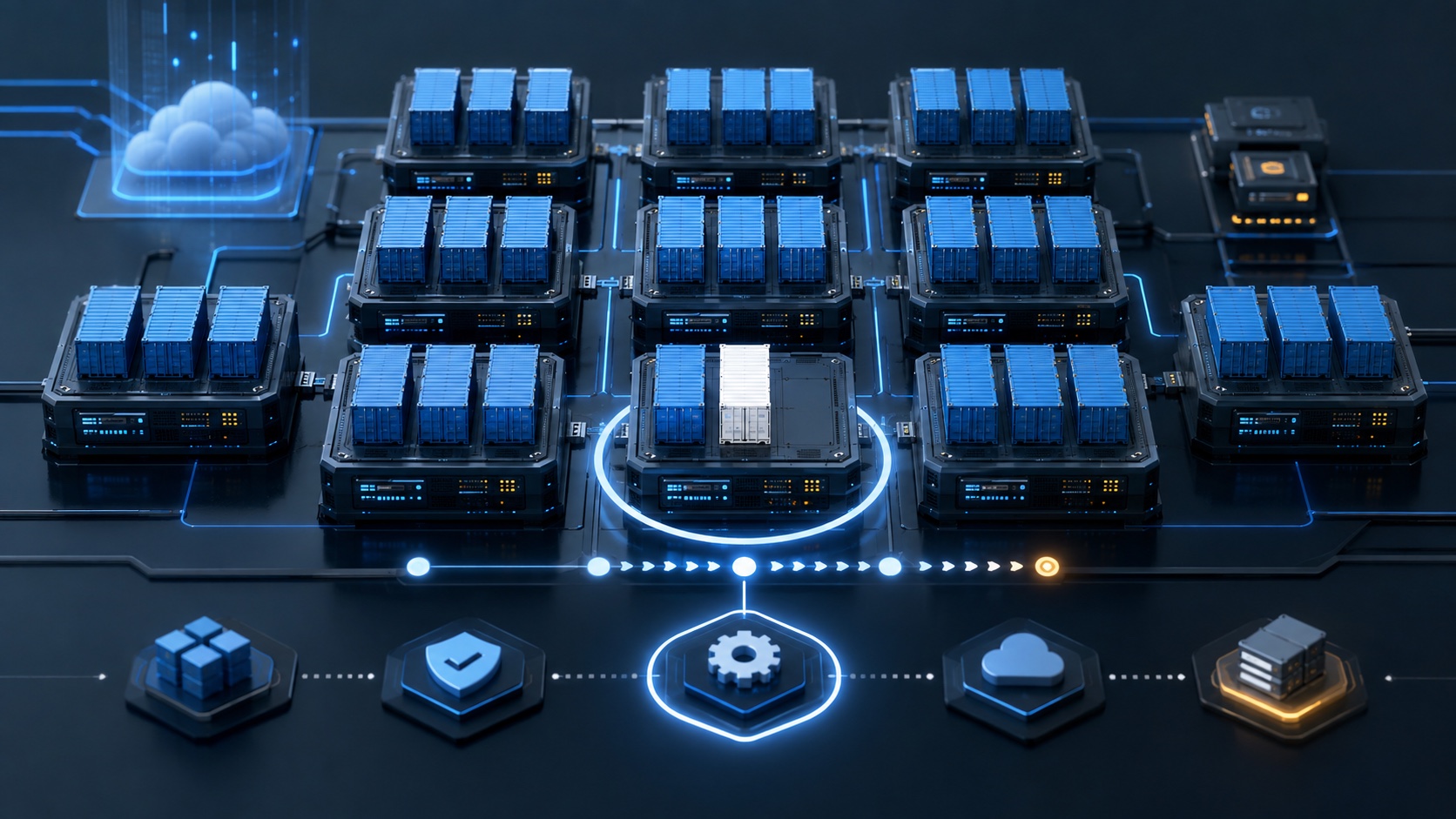
Replace one member at a time
A three-member cluster needs two members for quorum. Stopping two simultaneously makes it unavailable even when data remains intact. Stop one 3.6 member, replace its binary or image with 3.7 while preserving configuration and data, then wait for full recovery.
After each replacement, check:
- the health of every endpoint;
- the restarted member's status and version;
- leader presence and a coherent Raft term;
- unexpected lag or alarms;
- TLS, disk and corruption errors in logs;
- the Kubernetes API server or client application.
Continue only when those signals are stable. Automating the sequence without a health barrier merely accelerates a possible outage.
The cluster uses the lowest common version
During migration, 3.6 and 3.7 members can coexist. The cluster uses the lowest common protocol. Version 3.7 features become available only after every member is upgraded and the cluster version advances.
The mixed state also provides the simplest rollback window. While a 3.6 member remains and the upgrade is not final, a problematic 3.7 member can return to a compatible 3.6 binary or image.
Once the final member is upgraded and the cluster advances to 3.7, old binaries alone cannot roll it back. Recovery requires the earlier snapshot or the official downgrade procedure. The runbook should mark this explicitly as the point of no return.
Multiarchitecture images and Go integrations
Official etcd 3.7 images are published only as multiarchitecture images. Architecture-specific tags are gone. Deployments building image names with an amd64 or arm64 suffix need adjustment.
The move from historical protobuf libraries to google.golang.org/protobuf and updated gRPC interceptors should not affect normal binary users. It can break Go applications embedding etcd, importing internal modules or maintaining custom interceptors.
Those clients should compile their matrix against 3.7, run serialisation tests and verify OpenTelemetry metrics. A successful server upgrade does not prove compatibility for an integration importing internal packages.
Measure gains without changing production
CPU and memory improvements should be tested against a representative copy. Compare throughput, p95 and p99 latency, database size, disk stalls, watcher count and range-request costs.
RangeStream does not accelerate a client that keeps using the old RPC. The keys_only optimisation also targets specific requests. A test protocol must identify which workloads actually exercise each change.
For Kubernetes, observe API server latency, elections, leases and events under simulated load instead of relying only on a synthetic sequential-read benchmark.
Write the runbook before maintenance
The final procedure should be executable as a document:
- operation owners and communication channel;
- exact source and target versions;
- health commands and expected results;
- snapshot location and validation;
- member order and maximum waits;
- stop criteria after every node;
- point of no return before the final member;
- rollback and restoration procedures;
- application checks after migration;
- observation period before deleting old artifacts.
etcd 3.7.1 delivers useful improvements and removes debt that had become difficult to maintain. The upgrade remains manageable when treated as a quorum operation rather than a simple image-tag change. Success is not merely three processes reporting 3.7, but the team's ability to restore cluster state if the final restart exposes a problem.

Join the discussion
Comments
Loading comments…