
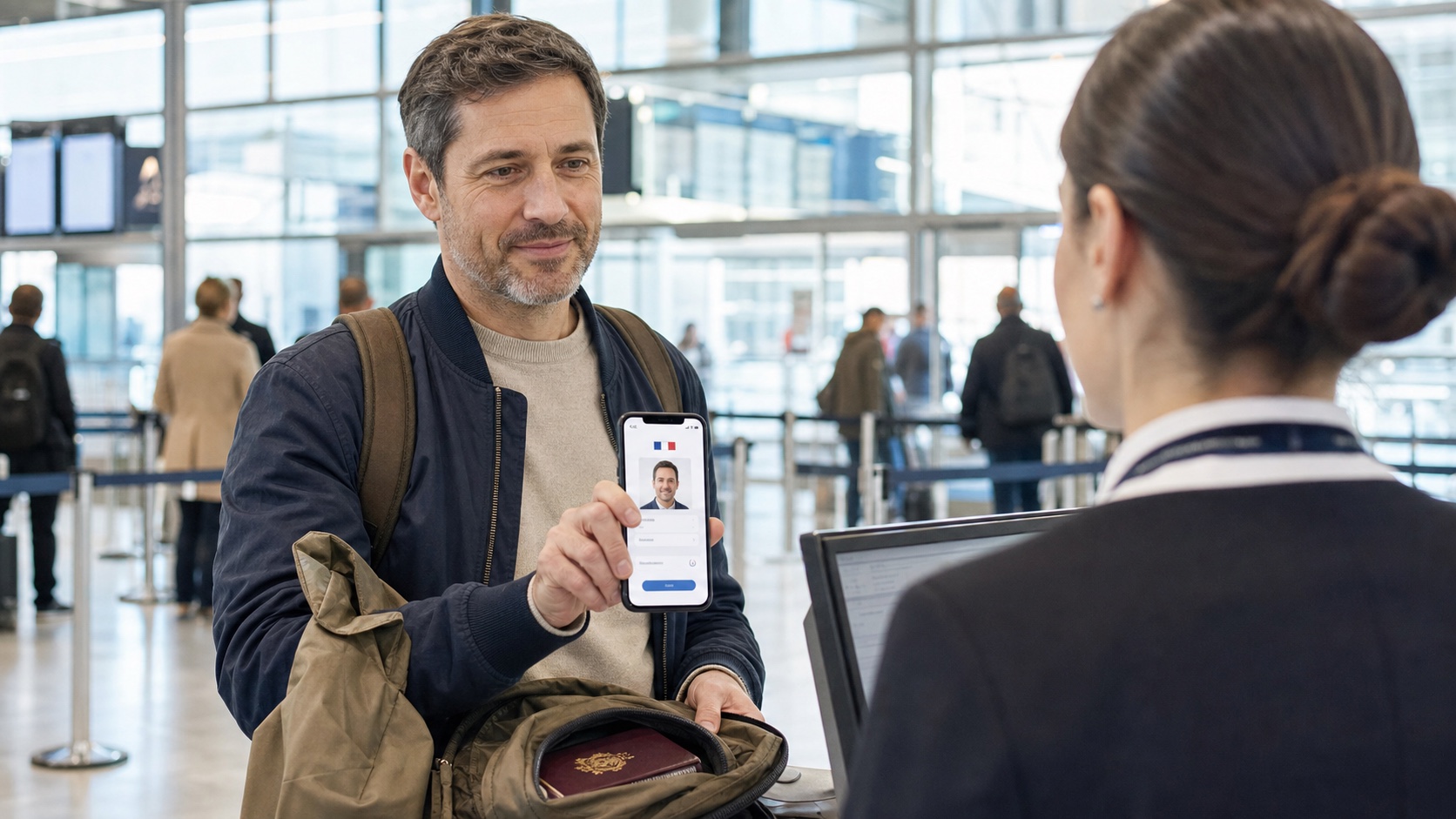
Travelers can now show a phone instead of searching for an identity card at the bottom of a bag in French airports. Since June 24, 2026, the digital ID card stored in France Identité can serve as proof of identity when checking a bag and boarding a flight.
The change is useful, but narrower than the phrase “travel with your smartphone” suggests. It covers checks performed by airlines in French airports. It does not replace a passport or physical identity card at border control, and it is not accepted as part of this scheme in foreign airports.
The short answer
| Situation | Is France Identité enough? |
|---|---|
| Checking a bag at a French airport | Yes, as proof of identity, alongside any other required travel documents. |
| Boarding at a French airport | Yes, regardless of the flight's stated destination. |
| A border police identity check | No. A valid physical travel document is still required. |
| Boarding from a foreign airport | No. The announced use does not extend to foreign airports. |
| A dead or broken phone, or an unavailable app | No. The traveler must be able to show an accepted physical document. |
The crucial distinction is between an airline's commercial check and a regulatory border check. The former can accept the France Identité screen in France. The latter still requires the documents mandated for the route and destination.
What actually changes at the airport
Before boarding, an airline checks that the name on a ticket belongs to a person carrying valid proof of identity. It also checks the necessary travel documents when accepting checked luggage. The new rule allows the front of the digital identity card to be displayed for this purpose.
The screen shown to staff contains the useful fields: first name, last name and photograph. France's Ministry of the Interior highlights this limited disclosure so that unrelated personal information remains hidden. Travelers are not expected to hand over an unlocked phone or allow staff to browse the app.
The intended gesture is straightforward: open France Identité, select the digital identity card from the home screen and display it full screen. The employee then compares the face, visible information and travel record.
The procedure is authorized in every French airport. However, an airline or employee may need time to become familiar with a new process. Arriving without any fallback can turn a small convenience into the risk of missing a flight.
Why travelers must still carry physical documents
One flight may involve several checks with different authorities and legal purposes. At boarding, the airline makes sure the correct passenger enters the aircraft. At an external border, police verify the person's right to leave or enter a territory. On arrival, local authorities apply their own rules.
France Identité now works for the first step in French airports. Service Public explicitly states that it cannot be used for identity checks associated with crossing a border. Nor is it announced as accepted proof in foreign airports.
For international travel, a passport or physical national identity card therefore remains essential, depending on the destination. Even on a domestic route, carrying an accepted document protects against a depleted battery, an outage, a blocked update or a damaged display.
The accurate summary is not “the phone replaces ID papers.” It is “the phone becomes an additional way to prove identity to an airline in France.”
Who can activate France Identité?
The service has several eligibility conditions. A user must be at least 18, hold the electronic national identity card in bank-card format and own a compatible smartphone. Service Public specifies Android 11 or iOS 16.6 as the minimum operating systems. The device also needs NFC support to read the CNIe chip.
Owners of the previous large-format card cannot simply photograph it. The digital identity relies on its secure chip and an activation process. Eligible residents may request an early free renewal to obtain the newer CNIe under the official conditions.
Using the app is optional. Physical documents remain accepted, and the digital route should not become the only way to access a service. That choice matters for people without a compatible phone, those who do not wish to digitize their identity and anyone uncomfortable with the application.
A checklist before leaving home
A few minutes of preparation can prevent an unpleasant surprise at the gate:
- confirm that the CNIe is correctly added and available in France Identité;
- update the application before the trip rather than over the airport network;
- open the digital card once and remember how to reach the full-screen view;
- charge the phone and carry a power bank for a long travel day;
- bring the physical document required by the destination and check its expiry date;
- review the airline, destination and transit-country requirements;
- never send a screenshot of the digital card to an unverified contact.
A screenshot does not provide the same assurance as a card opened inside the app. It may be stale, is easy to copy and can expose identity data permanently in a photo library or cloud backup. The official procedure is to display the dedicated France Identité view.
What data is displayed and stored?
For the announced airport use, the front-facing screen limits disclosure to the name, first name and photograph required for comparison. That can reveal less information than handing over a complete document with every field visible.
France Identité says identity data originates from the document held by the user and is not stored permanently on the service's servers. The photograph is encrypted and stored inside the application. Fingerprints contained in the CNIe cannot be read or processed by the service.
These principles do not make the phone invulnerable. An unlocked device, a shared passcode, a poorly protected backup or a counterfeit application still creates risk. Users should install France Identité from an official app store, protect the handset with a strong code and keep its operating system updated.
The next stage is European
The Ministry of the Interior connects this feature with work by the European APTITUDE consortium. A Marseille trial tested a journey involving passport data and a border crossing. Another experiment is planned at Geneva airport in September 2026 with several European digital identity wallets.
Those are trials, not universal border acceptance. A European wallet may eventually make digital credentials interoperable, but each expansion must identify participating authorities, exchanged data and a practical fallback.
The ministry says France Identité now has more than 4.5 million users. After digital driving licences, vehicle registration documents, voting proxies and some railway checks, airports bring digital identity into a highly visible everyday moment.
Useful convenience, not a reason to travel without backup
The immediate benefit is clear: a phone screen provides another identity option in a place where travelers already use a digital boarding pass. Selective display can also avoid revealing more information than an airline needs.
That convenience does not remove international rules or technical failure. Until France Identité is accepted at borders and abroad, the physical document remains what safeguards a trip. Travelers can prepare the app and use the smoother process while keeping their passport or identity card safely in their cabin bag.

Join the discussion
Comments
Loading comments…