
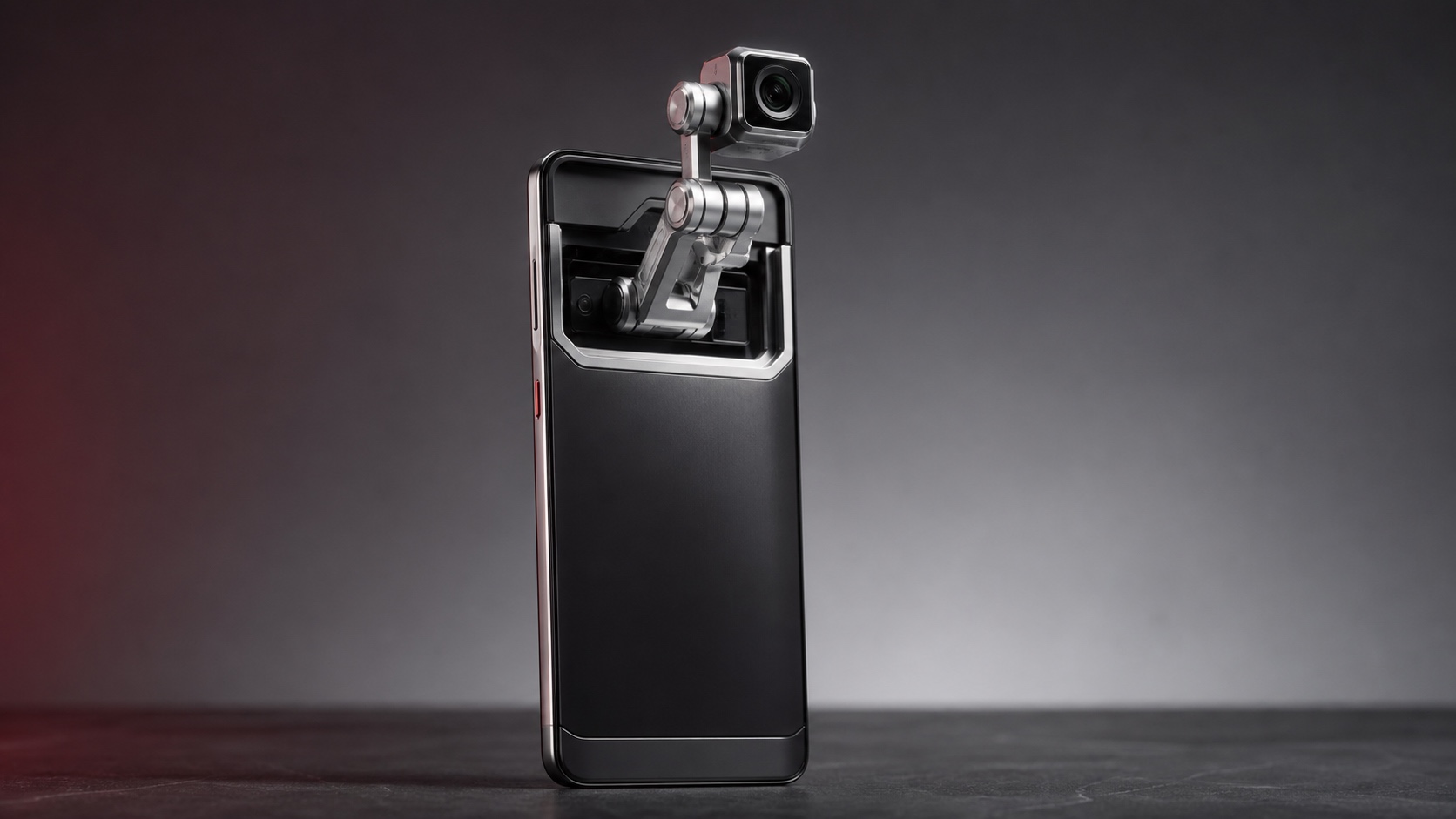
The HONOR Robot Phone moves from concept to commercial product today. First shown at MWC in March, this flagship smartphone has a camera on a motorized arm that unfolds from its back, rotates to follow a subject and stabilizes movement across three axes. Sales begin in China on August 18 at RMB 9,999, with no French price or release date announced.
The object immediately attracts attention, but its value is not that it can nod or dance. The real difference is turning the main camera into an integrated mechanical gimbal. The phone can keep someone framed during a call, follow a moving creator or produce camera moves normally handled by a separate stabilizer. In exchange, it adds motors, joints and a moving opening to the device most often carried in a pocket.
The short answer
| Question | Answer |
|---|---|
| What is a Robot Phone? | A smartphone whose main camera deploys on an AI-controlled motorized gimbal. |
| Is it a real commercial product? | Yes. Sales begin in China on August 18, 2026. |
| How much does it cost? | RMB 9,999 for 12GB + 512GB and RMB 12,999 for 16GB + 1TB. |
| Can it be bought in Europe? | HONOR has not provided detailed global availability or European pricing. |
| Why are there two 200MP cameras? | A stabilized main camera and a periscope telephoto cover standard capture and 2.7x optical zoom. |
| Is it an autonomous robot? | No. It remains a smartphone whose camera module has physical movement and tracking functions. |
A camera that physically unfolds from the phone
The mechanism brings together more than one hundred components in what HONOR describes as a four-degree-of-freedom gimbal. It includes an arm that deploys the camera and three-axis stabilization. Its titanium motor weighs 2.6g and is said to reach control speeds of 360 degrees per second.
HONOR claims it reduced system size by 65% compared with mainstream gimbals while doubling structural strength. Those figures come from the manufacturer and need independent teardowns and testing. They still illustrate the challenge: a joint small enough to fit inside a phone must resist acceleration, dust and thousands of deployment cycles.
The arm enables several behaviors. Tilt Lock holds the horizon, FPV modes follow rotation and AI SpinShot automates 90- or 180-degree movements. Subject tracking combines the moving hardware with software detection to keep a face or object in frame.
The most credible use case is filming alone
A creator filming themselves usually has to hold the phone, use a fixed tripod or attach a motorized stabilizer. Robot Phone combines those options. Placed on its magnetic stand, it can point at the person, follow them across a room and adjust framing without a camera operator.
That can help with video calls, remote teaching, cooking, exercise and live streams. Voice-source localization helps the phone decide where to turn, while gestures can deploy the arm and trigger capture without touching the display.
The benefit will depend on tracking quality. A fast motor is not enough if the algorithm loses a face, hesitates between two people or reframes abruptly. Reviewers will also need to assess mechanical noise in quiet rooms and whether repeated movements interfere with audio recording.
Two 200MP sensors and an ARRI partnership
The 200MP main camera uses a 1/1.28-inch sensor with an f/1.6 aperture and sits on the moving gimbal. A second 200MP sensor powers the periscope telephoto camera with 2.7x optical zoom, while a 50MP ultrawide covers 122 degrees.
HONOR partnered with cinema-camera manufacturer ARRI. The phone can record 10-bit ARRI LogC3, use the ARRI Wide Gamut 3 color space and preview ARRI Looks. The purpose is to retain more highlight and shadow information for grading in software such as DaVinci Resolve.
The partnership does not turn a small sensor into a cinema camera. Lens size, depth of field, heat management and compression remain constrained by a smartphone body. It could nevertheless make the color pipeline more predictable and give videographers a more flexible image in post-production.
YOYO gives AI a limited physical body
YOYO Robot Mode combines multimodal perception, gesture recognition, sound localization and physical movement. The phone no longer only displays a response: it can orient its sensor toward an event and express a reaction through motion.
HONOR calls this “embodied AI,” a phrase that needs perspective. Robot Phone's body is limited to its camera mechanism. It cannot move through a room or manipulate objects. Yet this embodiment is more concrete than an animated avatar because a software decision causes a real change in viewpoint.
YOYO Auto Execution is also meant to complete multistep tasks across supported apps and settings. An Agent Skills interface will let developers use the gimbal and sensors. The value of that opening depends on documentation, permission controls and how many applications actually integrate it.
Flagship specifications around the mechanism
Robot Phone uses Snapdragon 8 Elite Gen 5, a 6.31-inch LTPO OLED display with an adaptive 1–120Hz refresh rate and a 7,060mAh silicon-carbon battery. Charging reaches 120W wired and 50W wireless. Buyers can choose 12GB of memory with 512GB of storage or 16GB with 1TB.
The large battery looks necessary. Video tracking simultaneously loads the sensor, image pipeline, AI and several motors. HONOR promises all-day endurance, but only sustained stabilized-video tests will show how long the mechanism can operate before performance drops or the battery empties.
The advertised 6,800-nit peak brightness probably applies under limited conditions and does not describe sustained full-panel brightness. As with megapixels and motor speed, the maximum number must be separated from the everyday experience.
Durability, dust and repairability are the big unknowns
Conventional smartphones already contain fragile parts. Here, the camera module must unfold, survive possible sideways pressure and retract correctly. A fall with the arm deployed is the obvious failure scenario. Sand or a fiber could also interfere with a precision joint.
HONOR emphasizes materials engineering and its foldable-phone experience, but the global launch announcement does not detail a Robot Phone-specific ingress rating, certified cycle count or camera-module replacement price. Those facts matter more for a durable purchase than the device's ability to dance in a demonstration.
A case presents another challenge. It needs to leave the mechanism clear without making the back excessively thick. The included magnetic stand may reduce handling, but it cannot protect an already deployed camera. Early stress tests and spare-parts availability will therefore be decisive.
Privacy: a tracking camera draws more attention
Automatic tracking requires continuous image analysis and sometimes audio processing. Users need to know which operations remain on device, what data reaches YOYO services and how to disable voice localization. A clear indicator should show when the camera is active, especially if the phone can turn toward a person on its own.
Movement makes capture more visible, which may paradoxically improve awareness among people nearby. It can also cover more of a room than a fixed camera. In an office or shared home, consent should not be reduced to a device-owner setting.
Should European buyers wait?
Robot Phone is initially an expensive Chinese-market product. At RMB 9,999 for the base version, it targets enthusiasts and creators willing to accept first-generation risks. Importing adds questions about network bands, software services, languages, warranty and repair.
For most European users, waiting for a regional announcement is the sensible decision. It will clarify tax-inclusive pricing, locally available YOYO functions and service terms. A normal smartphone paired with a good external gimbal remains less spectacular, but probably easier to replace and repair.
Robot Phone does not reinvent every smartphone function; it finally makes the camera observing them mobile. If the mechanism lasts and tracking feels natural, HONOR will have created a genuinely new capture tool. If not, the motorized arm will remain an impressive demonstration attached to an excellent phone.


Join the discussion
Comments
Loading comments…