
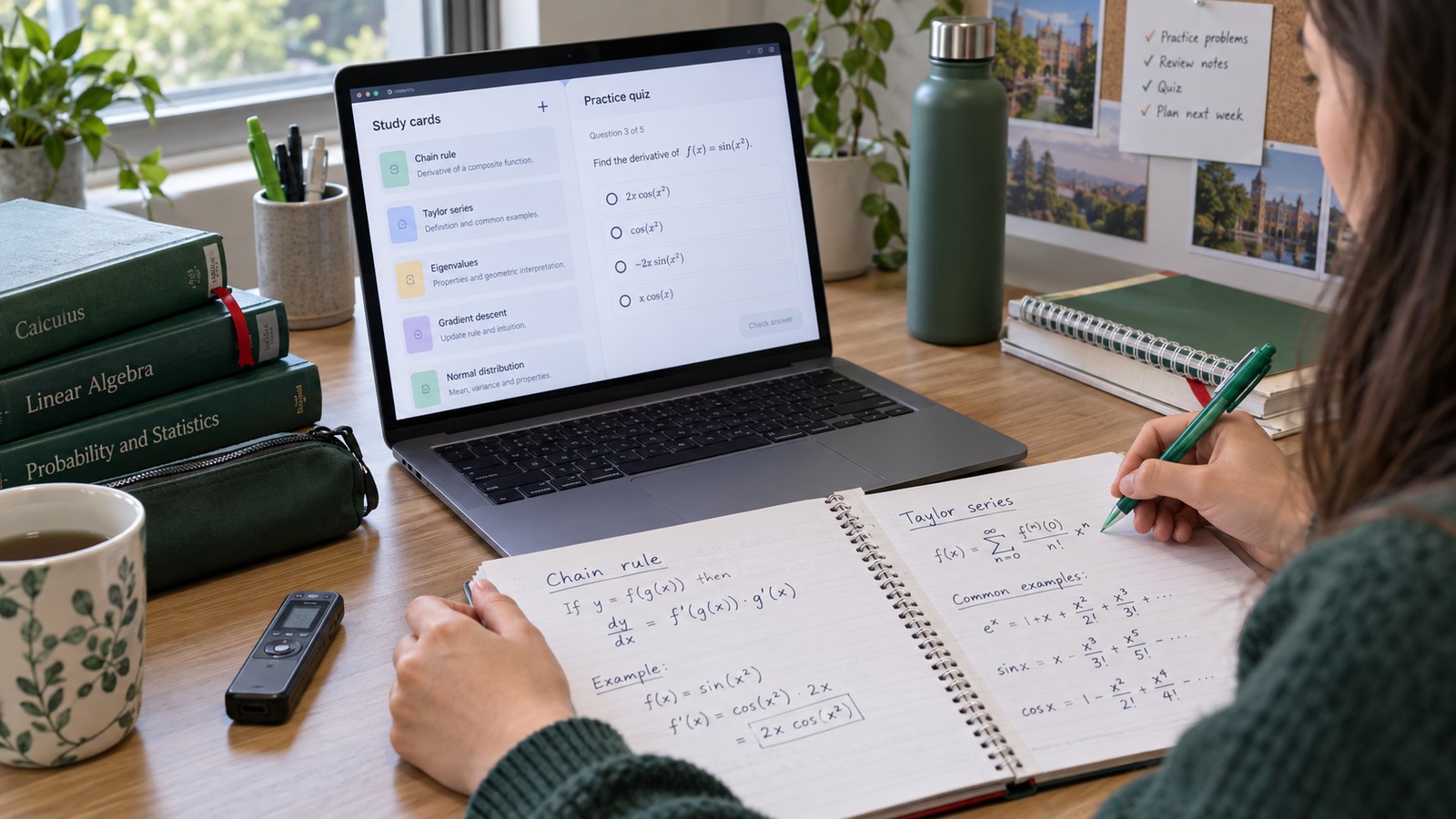
A revision sheet can feel familiar even when you cannot explain the lesson. That gap is where Gemini Notebook's expanded study tools could help: asking questions, reformulating ideas and returning to documents instead of simply reading another summary.
Google announced quizzes, flashcards, short video summaries and source-based voice conversations on September 15. Access varies by rollout, feature and plan; some voice capabilities initially target adult Ultra subscribers. The announcement explains those limits.
Use the tool to create useful difficulty
Our recommendation is to make the assistant prepare questions you answer without looking at your notes. That exposes hesitation. Summaries can follow, helping you revisit the parts you found difficult.
For a networking lesson, instead of asking for a chapter summary, request questions that distinguish an IP address, a domain name and an encrypted connection. Answer in your own words. Then compare your explanation with the original course material, rather than treating the chatbot's wording as the definitive answer.
This approach also works with a paper notebook. The software makes exercises easier to prepare; it does not make every generated correction authoritative.
Begin with a small, trustworthy source set
Before generating a quiz, inspect the uploaded documents: the relevant course, clearly labelled notes and a complete chapter. An outdated handout or incomplete file can steer the entire session in the wrong direction.
Start with one chapter. Errors and omissions are easier to spot when the scope is limited. Combining many files can produce a convincing sense of completeness even when some details are missing.
For an exam, preserve the terminology your instructor expects. A fluent paraphrase may help understanding but still fail to express a definition or proof precisely enough.
Voice helps explanation, not certification
Explaining a concept aloud can reveal what remains unclear. Try a two-minute explanation, then list the claims you need to verify. The value comes from your effort to formulate an answer, regardless of whether the assistant subsequently sounds encouraging.
Before recording a lecture, check institutional rules and permission from the people involved. Having access to a recording feature does not automatically authorise recording a conversation or uploading it to an external service.
Choose a quiet place for a first voice trial. If you spend the session correcting transcription errors or repeating ambiguous terms, a written exchange may be the more useful format for that topic.
Short videos introduce rather than replace reasoning
A one-minute overview can orient you, but it cannot replace the steps of a proof or worked problem. Afterwards, ask whether you can solve a different example. If not, return to the exercises and original documents.
Avoid generating more material than you use. Ten stored flashcard sets are less useful than one session that identifies and corrects a misunderstanding. File volume is not evidence of learning.
Try a small experiment
Choose one concept, answer five questions and repeat the exercise the next day without rereading the answers. Record which points remain difficult. This gives you a personal basis for evaluating the tool without promising a numerical improvement in grades.
For broader comparisons, our ChatGPT, Gemini and Le Chat article explains what to assess for different needs.
Cover visual: an illustration generated for this article, not an official service screenshot.

Join the discussion
Comments
Loading comments…