
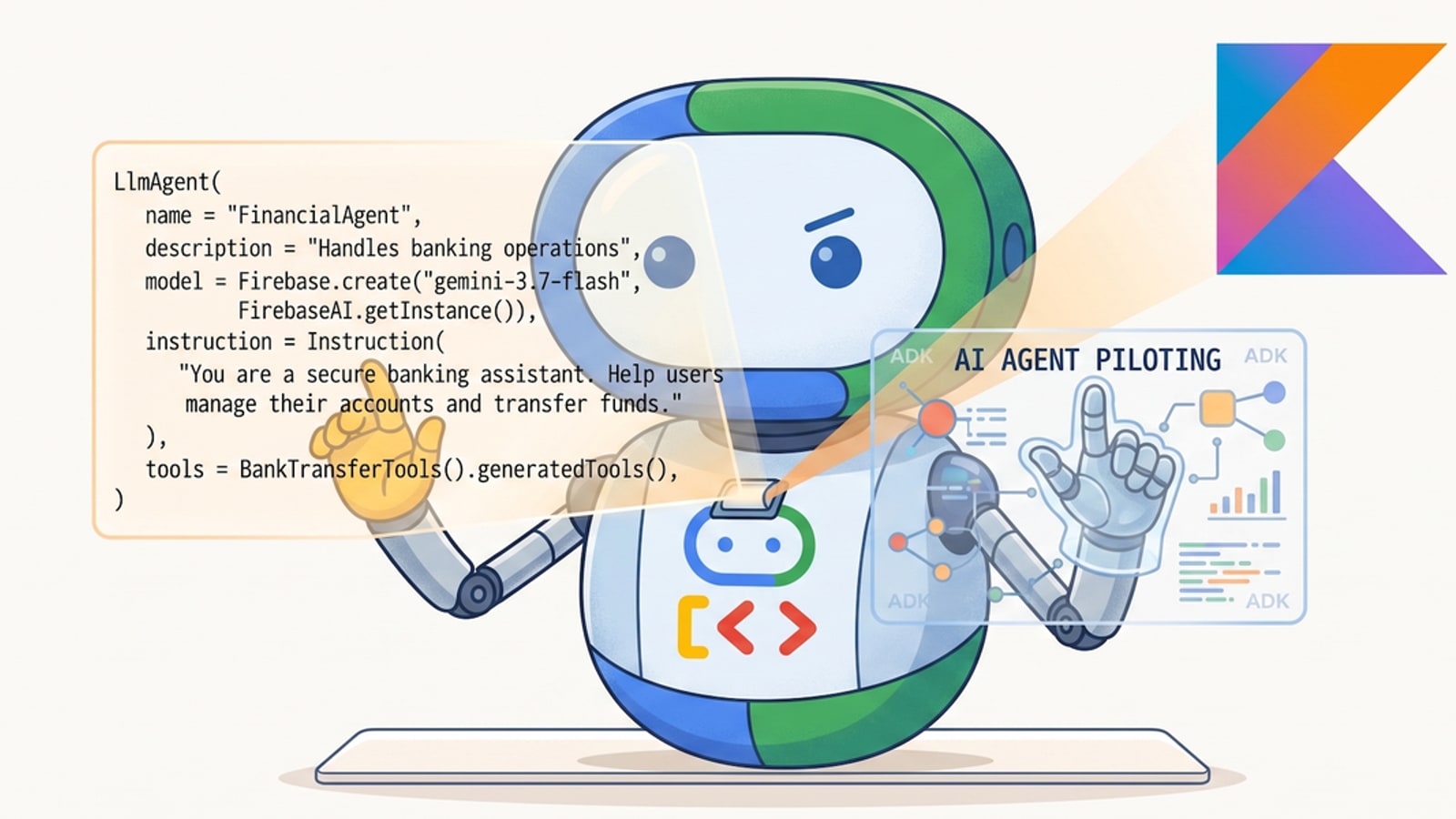
Google has made ADK for Kotlin 1.0 generally available for building AI agents in Kotlin, Java and Android. The release reaches parity with the Python and Java core while adding mobile-focused and on-device extensions.
Quick answer
| Capability | Benefit |
|---|---|
| Kotlin Multiplatform | A core independent of model and storage providers. |
| On-device execution | LiteRT-LM and ML Kit integrations, still in beta. |
| Human control | Pause, confirm and resume sensitive actions. |
| Persistence | Restorable Android sessions through Room and AppSearch. |
Composable agents, not only chatbots
ADK coordinates specialized child agents, compacts context during long conversations and serializes sessions for later resumption. Kotlin tools use @Tool and @Param; KSP generates their schemas at compile time without runtime reflection.
That brings static typing to integrations that often rely on brittle JSON descriptions. First-party Java interoperability also makes adoption more realistic in an existing JVM codebase.
Local and hybrid Android execution
Mobile teams can combine local models through LiteRT-LM or ML Kit with Firebase AI Logic for cloud tasks. Room, AppSearch and Android storage preserve session state, indexed memory and files. A hybrid design can keep sensitive data or low-latency responses on the phone.
“Production-ready” does not mean every component is final. Google still labels parts of the local stack as beta, so teams must test battery use, device coverage and offline behavior.
Guardrails as a first-class feature
Human-in-the-loop flows can stop an agent before a transfer, message or destructive operation. Skills load procedures and supporting resources only when required, reducing context while giving the agent an explicit playbook.
Server-side authorization remains essential. A confirmation dialog is meaningful only when identity, permissions and audit logs are enforced behind it.
What version 1.0 changes
Kotlin teams now have an official route that does not require moving all orchestration into a Python service. A sensible first deployment is still narrow: a few reversible tools, observable execution and a defined failure path. The release will prove itself through maintainable Android and JVM systems rather than the number of impressive demos.



Join the discussion
Comments
Loading comments…