
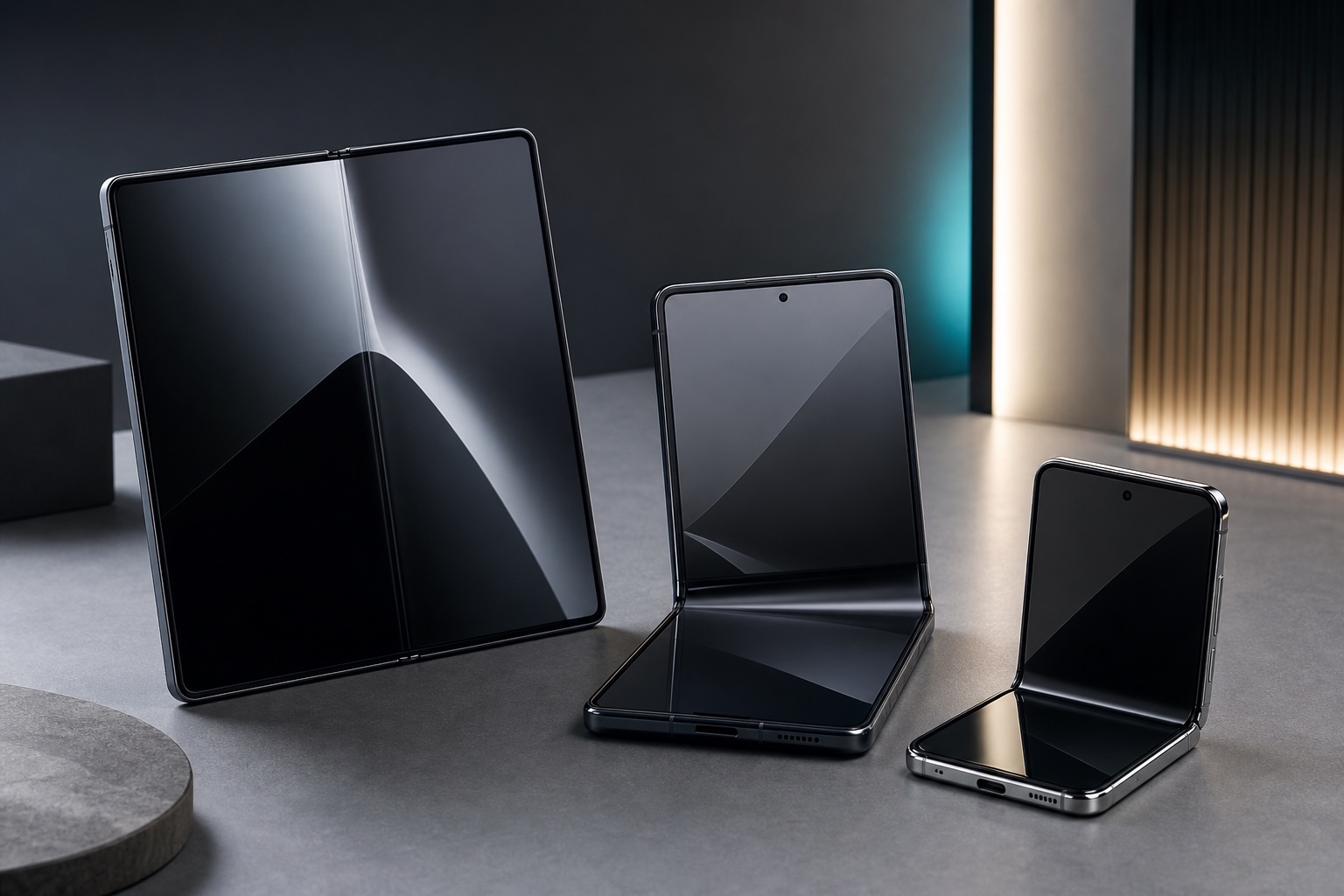
For years, buying a foldable smartphone mostly meant accepting a list of compromises in exchange for a spectacular screen. The device was heavier, thicker and seemingly more fragile than a conventional phone. Its price sat above many premium models, while the closed form was not always comfortable for everyday use. With the Galaxy Z Fold8 Ultra, Galaxy Z Fold8 and Galaxy Z Flip8, Samsung is trying to change the conversation. The question is no longer simply "should I buy a foldable?" but "which kind of foldable actually fits my use?".
That shift matters for mainstream buyers. Samsung no longer presents the foldable as a single technology showcase. The range now splits into three propositions: a Fold8 Ultra focused on productivity and maximum screen space, a lighter Fold8 designed around content, and a Flip8 that preserves the idea of a full-size phone folding into a compact object. This segmentation looks more like an established product family than an experiment at the edge of the market.
It does not remove every concern. Price, hinge durability, repairability and the real value of the larger screen still matter. But it requires buyers to look beyond the initial demonstration effect.
Fold8 Ultra embraces the mini-tablet role
The Galaxy Z Fold8 Ultra is the model that most closely matches the historic Fold concept: a phone that becomes a small tablet. Samsung announces an 8-inch main screen, a thickness of 4.1 millimeters when unfolded and a weight of 215 grams. It uses the Snapdragon 8 Elite Gen 5 for Galaxy platform and a 5,000mAh battery.
Those numbers describe a clear position. The Ultra is for users who want to display two apps, read documents without constant zooming, edit content or carry a workspace closer to a tablet than a phone. The large display is not only for video. It is intended to keep a conversation next to a document, compare two pages or use AI tools without hiding the main content.
Samsung also highlights changes to the hinge, display tension and structure through its Flex Titanium technology. The stated goal is to reduce the visible crease and improve durability. Longer testing will be required to separate measurable progress from product messaging. On an expensive device, its condition after thousands of folds matters much more than the impression it makes during a few minutes in a store.
The Ultra is therefore the most ambitious option, but not automatically the most rational one. Its value depends on how often the inner display is genuinely used. If the owner rarely unfolds the phone, they are mostly paying for a capability left idle.
Fold8 changes its priority
The standard Galaxy Z Fold8 takes a different route. Its 5.5-inch cover screen uses a 10:16 ratio, while the 7.6-inch inner display adopts 4:3. Samsung emphasizes content adaptation: a horizontal format for movies and games, and a vertical orientation that feels more natural for reading and browsing. At 201 grams, it is the lightest Galaxy Z Fold announced by the company.
That weight is a more concrete argument than a long feature list. A phone is carried for hours, held with one hand on public transport and expected to remain reasonable in a pocket. A foldable approaching the weight of a conventional smartphone removes one of the largest adoption barriers.
The 4,800mAh battery is rated for more than 26 hours of video playback. As always, that measurement does not precisely predict real battery life with 5G, photography, navigation and background apps. It does indicate that Samsung is not presenting the lighter design as an obvious sacrifice in that area.
Fold8 therefore appears less like a pocket computer and more like an entertainment screen that remains usable when closed. That may be the clearest proposition in the range: provide a larger display when desired without permanently imposing the Ultra model's weight and dimensions.
Flip8 remains the compact option
Galaxy Z Flip8 answers a different need. It does not try to turn a phone into a tablet. It tries to make a large smartphone more compact when closed. Its external FlexWindow supports quick information, controls and selected AI interactions without requiring users to open the device completely.
This format retains a straightforward advantage: it changes how the phone is carried without imposing a large square inner screen. For people who primarily want a smaller object in a pocket or bag, Flip remains more coherent than Fold. Its hinge can also help with supported photography, video calls and framing.
The tradeoff is that the functional gain is less dramatic. Once opened, Flip is close to a conventional smartphone. The purchase is justified by compactness, design and external-screen uses, rather than by a major productivity transformation.
AI becomes an interface layer
Samsung accompanies the three devices with what it describes as agentic features. On Fold8, the company shows a user sharing a photo of the Eiffel Tower with Gemini and asking it to find a nearby hotel. The agent can prepare recommendations while other apps remain in use, then request approval before important actions.
The foldable's value becomes clear in this scenario. On a conventional screen, an assistant often covers the current app. On a larger display, the request, results and reference content can remain visible together. Hardware does not automatically make AI more intelligent, but it can make the interaction less intrusive and easier to supervise.
The word "agent" still deserves caution. Finding information and preparing an action is not the same as booking correctly, staying within a budget or understanding every travel constraint. Visible confirmations and a clear path back to the original app remain essential.
Questions to ask before buying
The first criterion is not the specification sheet but unfolding frequency. Someone planning to work on the large screen several times a day may justify Fold8 Ultra. A buyer focused on video, reading and lower weight may prefer Fold8. Someone who simply wants a compact phone when stored will likely find Flip8 more relevant.
The second criterion is total ownership cost. Insurance, display repair, parts availability and support duration belong in the calculation, not only the retail price. A foldable remains mechanically more complex than a slab phone.
The third is tolerance for compromise. The central crease, closed thickness and the way apps handle unusual aspect ratios can still be distracting. A hands-on test in a store is more informative than comparing numbers alone.
Samsung's 2026 Galaxy Z family does not prove that everyone needs a foldable phone. It shows that the market is beginning to offer different answers to different needs. That is more meaningful than another reduction in thickness: foldables are gradually becoming choices of shape and behavior, with benefits buyers can finally compare against their own habits.
Join the discussion
Comments
Loading comments…