
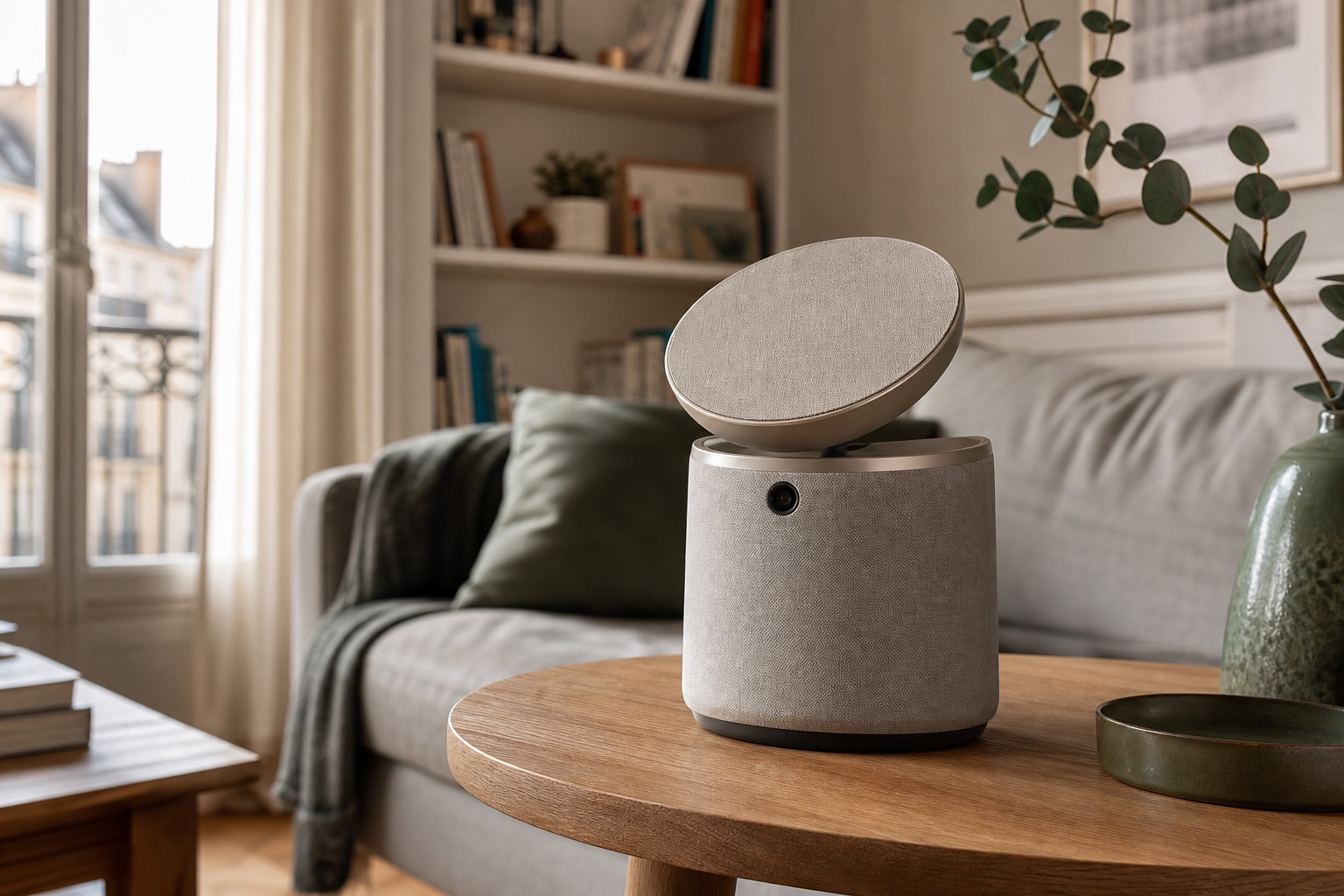
OpenAI's first consumer device may be neither a phone nor a pair of glasses, and not quite a conventional smart speaker. According to reporting by Bloomberg, subsequently covered by TechCrunch, the company and Jony Ive's team are working on a portable home object with no screen. It would speak, observe its surroundings and move some of its mechanical parts. The ambition would be to give ChatGPT a physical presence and create a more natural relationship than an app can provide.
The conditional language matters. OpenAI has not unveiled a finished product, technical specifications, a price or a definitive public schedule. The available details come from unnamed sources and may still change. What is confirmed is the company's hardware ambition: in 2025, OpenAI acquired io, the company founded by Jony Ive and former Apple design leaders, in a transaction valued at about $6.5 billion. It has also hired an experienced executive to lead communications for its devices division.
The project therefore deserves more than a quick comparison with an Amazon Echo or Google Nest. It asks how much room people are prepared to give an AI inside their homes.
Designed around voice instead of a screen
The missing display would be the defining decision. A phone shows what it has understood, lets someone reread an address and provides a clear button to cancel an action. A voice device must communicate those states differently. It can be more immediate for setting a timer, requesting a recipe or summarizing a message, but less effective when comparing prices, checking a date or reviewing several options.
OpenAI appears to be betting on conversations fluid enough to reduce that dependence on a display. The device is reportedly conceived as a "companion," not a terminal waiting for exact commands. It could use context, remember preferences and intervene more proactively.
That promise is attractive because it removes friction: no phone to retrieve, unlock and navigate. It is also risky. When an answer is not visible, users have more difficulty distinguishing a fact, a suggestion and an action that has already begun. A confident voice can sound more reliable than the underlying result deserves.
Movement would give the machine a presence
Reports mention mechanical elements that can move on their own. This does not necessarily mean a robot roaming around the home. It could instead be an object able to orient a sensor, signal attention or physically react during a conversation.
The detail sounds cosmetic, but it affects how people interpret a machine. Turning toward a speaker, making a small movement or displaying a light can create the impression that a device is listening and understanding. Designers can use those cues to clarify an interaction: showing that the microphone is active, indicating whom the assistant is addressing or signaling uncertainty.
The same cues can manufacture artificial closeness. An object that imitates attention may be perceived as more capable, empathetic or trustworthy than it really is. The challenge is not merely to avoid an uncanny design. The system's state must remain legible without turning every animation into an emotional promise.
Camera use and personal data will be decisive
An assistant that can see a room can handle requests beyond a traditional speaker. It might identify an object, read a label, guide a repair or notice that a stove has been left on. Some functions could be genuinely useful to older or visually impaired users.
A domestic camera connected to an AI model also raises the sensitivity level. It can capture faces, documents, the interior of a home and the habits of several people who did not all choose to use the service. A status light is not enough if users cannot tell when images leave the device, how long they are retained or whether they improve future models.
The product would need obvious hardware controls: a physical camera shutter, electrical microphone cutoff and an indicator that cannot be disabled while sensors operate. Memory settings should be accessible without a long conversation. The device must also distinguish the owner's account from guests, children and other household members.
Trust will depend less on a broad privacy statement than on these concrete choices.
A companion that acts must know when to ask
The value of OpenAI hardware is unlikely to come from encyclopedic answers. A phone already provides those. It would come from using services: reading messages, preparing a shopping list, managing a calendar, controlling the home or placing an order.
As the assistant gains the ability to act, confirmation becomes more important. Drafting a tentative appointment and buying a product should not follow the same path. A payment, data transfer or door unlock needs strong validation. Without a screen, that might involve a phone, voice identification combined with another factor, or a physical control on the device.
Voice recognition alone is not sufficient security in a home where a television, recording or another person may speak. The product must also explain what it is about to do, which account it will use and which information it will share before execution.
Why not just use a smartphone?
This is the central question. ChatGPT already supports voice conversations on phones, and mobile systems have cameras, location and a display for confirmation. To justify new hardware, OpenAI must show that it understands shared space better and stays available without becoming intrusive.
Battery life, microphone quality, response time and smart-home integration will matter more than model power alone. Pricing must be compared with the combined cost of a speaker, camera and subscription. If the most useful functions require an expensive monthly plan, the device may remain a premium curiosity.
There is also a social problem. Speaking to AI in a shared room is not always appropriate. A medical request, work message or personal question should not be broadcast to the household. Removing the display simplifies some interactions but also removes the silent channel that makes a phone discreet.
What an official launch must clarify
An actual presentation will need to answer straightforward questions: which sensors are included, which operations remain local, what memory is retained, which services work and what happens without a connection. Buyers will need to know the software support period, whether mechanical components can be repaired and how stored information is protected if the device is stolen.
Most importantly, reviewers should test ordinary situations. Does it understand a request in a noisy kitchen? Can it recognize when it is speaking to a child? Is it easy to inspect and correct an answer? Does it remain useful when camera access, memory and personalization are disabled?
A screenless companion is interesting because it challenges the assumption that every digital task needs another app. It will only be convincing if it offers more control while demanding less attention. A device that listens, sees and remembers could become a practical interface. Without precise safeguards, it could also become the most intimate sensor in the home.
Join the discussion
Comments
Loading comments…