
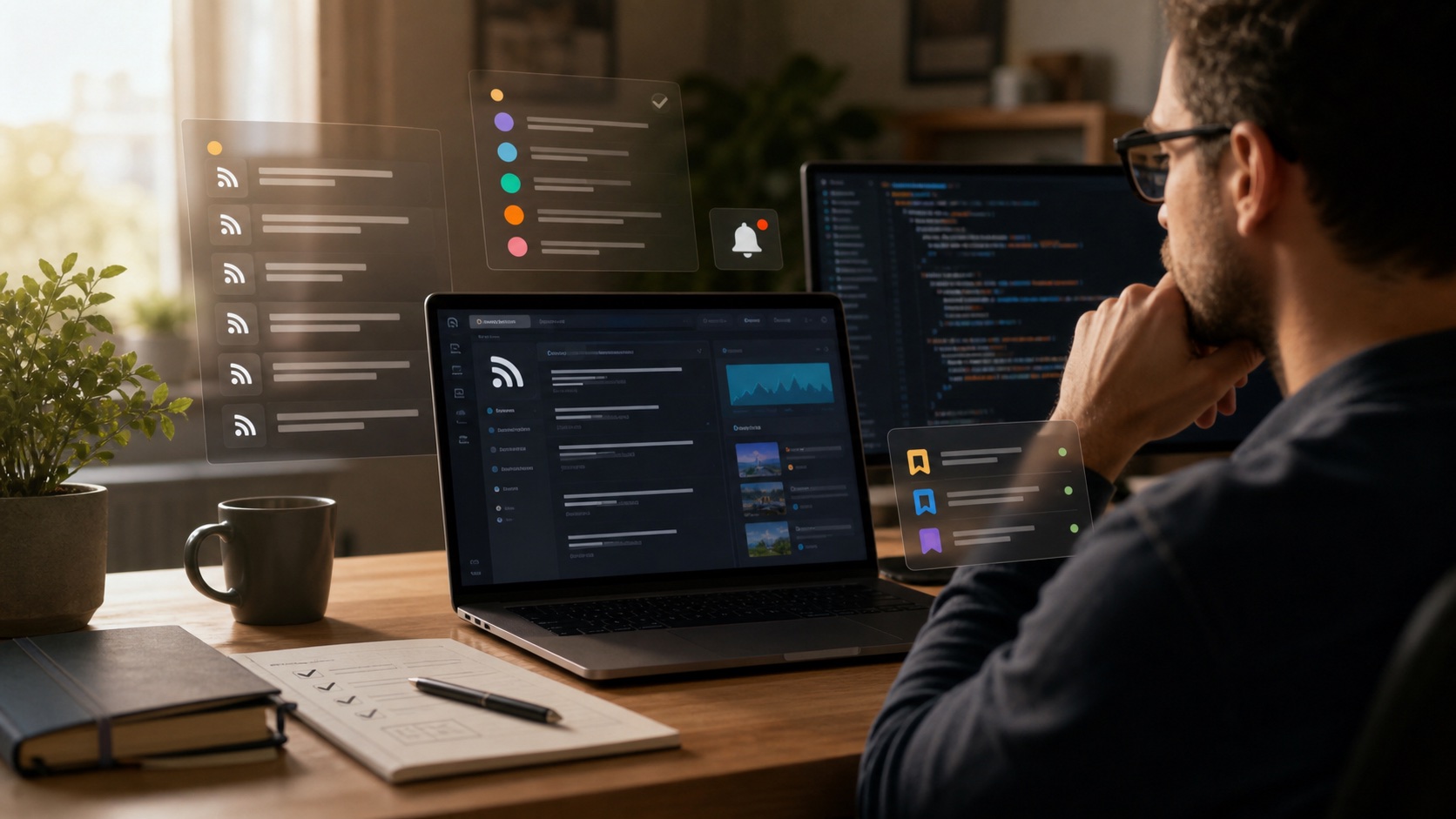
Developer watch becomes unproductive when it piles up announcements without hierarchy. New releases, vulnerabilities, frameworks, AI tools, pricing changes, new APIs: everything looks important for a few minutes. In practice, most signals do not require an immediate decision.
The goal is not to read everything. A good watch routine identifies what needs action, what should be archived and what can disappear without consequence. For an engineering team, that routine matters as much as the tool used to manage it.
Reduce sources before adding feeds
The common reflex is to follow more accounts, newsletters and websites. The better move is often the opposite. A usable watch starts with a small number of reliable sources: changelogs for the services already used, official blogs for the languages and frameworks in the stack, security bulletins, a few tech media outlets and experience reports from similar teams.
The GitHub Changelog, Node.js blog and MDN blog are good examples of primary sources. They do not replace media coverage, but they help separate an official announcement from an interpretation, rumor or opportunistic tutorial. Media coverage then adds context: adoption, limits, market impact and user feedback.
Filter with three questions
The first question is impact. Does the announcement change an API, license, vulnerability, infrastructure cost or browser compatibility? If yes, it deserves a note. If it changes nothing in production or the roadmap, it can wait.
The second question is maturity. An interesting experiment does not deserve the same attention as a stable release, an official deprecation or an actively exploited vulnerability. Many trends are worth knowing about without entering the backlog immediately.
The third question is proximity. Something new in the existing stack is often more valuable than a widely discussed topic far away from the product. For a Vue/Nuxt team, a framework change, Node.js runtime update, browser behavior shift or content engine change will matter more than a spectacular demo with no architectural connection.
Turn reading into decisions
A useful watch should produce more than a pile of links. Each note should be classified into four states: ignore, monitor, test, plan. This prevents every new thing from becoming urgent.
A minor version change may simply be archived. An announced deprecation can become a dated task. A critical vulnerability should trigger dependency checks. A promising new API can enter a limited experiment with a clear goal and exit criterion.
Keep a searchable archive
The best format is often the simplest one. A Markdown file or versioned note collection is enough to start: title, date, source, summary, impact, decision and links to any related tickets. What matters is being able to find the information three months later, when someone asks why a migration was delayed or why a tool was tested.
That archive also supports editorial work. For a tech news site, the same discipline can feed short articles, long explainers, archives, search and RSS without rewriting history every time something is published.
A realistic routine
Fifteen to twenty minutes per day is enough for hot monitoring: scan priority sources, mark important signals and note risks. A longer weekly session turns notes into decisions: tests, tickets, updates, articles or rejection.
The most important rule is protecting attention. A watch routine that interrupts the whole day is no longer watch. It is noise. A watch routine that arrives at the right time, with the right filters and a clear trace, becomes a technical steering tool.


Join the discussion
Comments
Loading comments…