
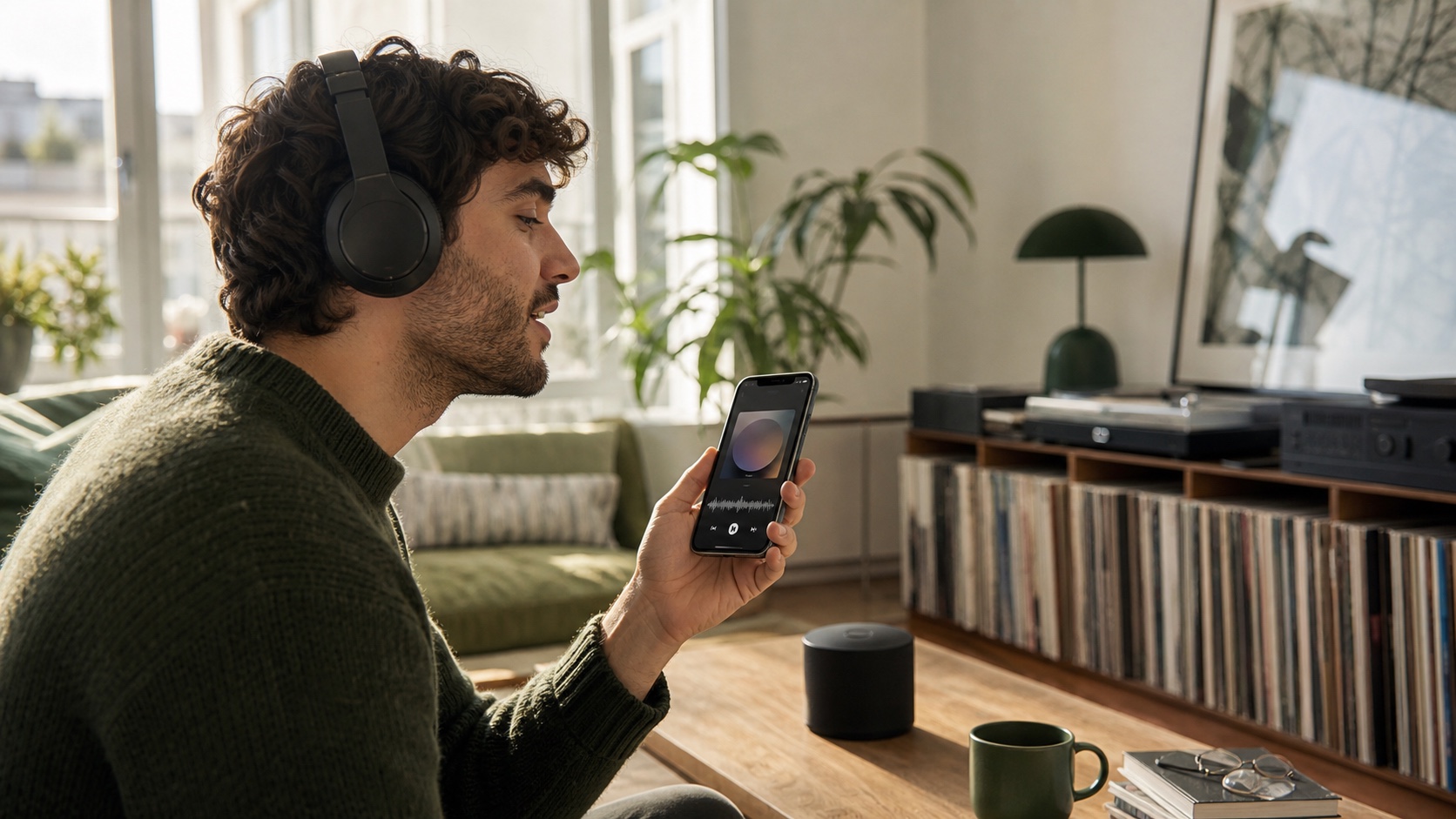
Choosing music in a streaming app still relies mainly on three actions: searching for a title, opening a playlist or accepting a recommendation. Spotify is now testing a different model. Instead of moving through screens, listeners can speak or type to the app, request a mood, correct the proposal and control playback without starting the search again.
The feature, called Talk to Spotify, is rolling out gradually in beta to selected Premium subscribers aged 18 and over in the United States, Ireland and Sweden. It works in English on iOS and Android. Its limited availability matters, but its scope offers a clear view of streaming's next contest: turning an enormous catalogue into a personal conversation.
What listeners can ask
Spotify describes four broad uses. The first starts a listening session from an intention rather than an exact title. A request such as “play artists I haven't heard before” can be refined during the conversation by adding an artist, retaining only recent releases or making the selection more upbeat.
The second use covers commands. Listeners can ask to save a song, add it to the queue or follow an artist. These are not merely informational answers: the conversation directly changes the listening session.
The third use adds context. From the Now Playing view, Spotify suggests asking about a song, album, genre or an artist's inspiration. The feature also extends to podcasts and audiobooks, for example to find other books by an author or other podcasts featuring a guest.
Finally, the assistant can explore personal listening history. It can answer questions about when a song was first played or which genres have featured most recently. Spotify is using an advantage that is difficult for a general-purpose assistant to reproduce: years of playlists, favourites and listening habits already connected to the account.
Search that accepts uncertainty
Traditional search works well when a listener knows a song's name. It is less effective for an imprecise need: calm music that is not sad, a familiar selection with a few discoveries, or a podcast similar to one particular episode. The necessary filters rarely exist as buttons.
A conversation can build the request in stages. Listeners do not need a perfect instruction at the outset. They can hear the result, explain what does not fit and retain what works. That loop is closer to speaking with a music programmer than entering a query into a search engine.
The benefit will depend on whether context genuinely persists. If every correction discards earlier constraints, or if ordinary terms are regularly misunderstood, the experience will be slower than selecting a playlist. Spotify acknowledges that the beta is a work in progress and is asking users for feedback.
Voice is only the entry point
Calling the feature a voice command would understate it. Voice assistants can already start an artist or change the volume. Talk to Spotify instead attempts to connect three layers: understanding an intention, knowing the listening profile and executing actions inside the app.
Users can type rather than speak. That option matters on public transport, at work or whenever privacy makes saying a request aloud undesirable. The product's value comes less from the microphone than from its ability to maintain context and act on the catalogue.
This development moves specialist applications closer to embedded agents. The difference from a general chatbot lies in access to data and tools: the assistant knows the library, history and current playback, then can change the queue. Its domain is narrow, but within that domain it has practical controls.
What Spotify will need to explain
A conversational recommendation can sound like neutral advice. The result still depends on ranking decisions involving past taste, popularity, new releases, availability by region and discovery objectives. Natural language does not remove these choices; it may make them less visible than a results list.
Spotify will need to help listeners understand why a selection appears and make correction easy. “More new releases” is not the same instruction as “more artists I don't know.” A useful assistant must distinguish between them without trapping users inside their history.
Data use also matters. Asking about listening habits immediately reveals how detailed that history can be. Users will need to know what information is used in an answer, how long voice requests are retained and which controls govern personalisation. The launch announcement explains the capabilities but does not yet detail every policy that would accompany a global rollout.
Why availability remains narrow
The beta is restricted to adult Premium users in three countries and works only in English. That caution reduces the number of languages, catalogues and regulatory environments involved. Understanding a musical nuance, an accent or an artist's name is more demanding than processing a fixed command.
Its absence elsewhere does not confirm that a wider launch is imminent. Spotify only says that the experience is rolling out gradually and that more updates will follow. Users outside the test markets should not install unofficial software or give credentials to a service claiming to unlock the feature.
An interface that could reshape apps
Spotify's experiment reaches beyond music. Many applications contain catalogues that are too large for their menus: video, retail, travel, cooking and education. Conversation can become another navigation layer when it understands context and triggers verifiable actions.
It will not replace every screen. Browsing artwork, comparing several options or managing a long playlist is still more efficient in a graphical interface. The credible model is hybrid: conversation prepares or narrows a selection, and the screen provides precise control over the result.
For Spotify, the challenge is to make recommendations more interactive without turning listening into a permanent dialogue. If the beta delivers, requesting a mood and correcting it in a few words could become as natural as launching a playlist. If it does not, the microphone button will remain an impressive feature that listeners forget after a few trials.


Join the discussion
Comments
Loading comments…